
You scrubbed it until your arms ached on Saturday. By Tuesday, that same chalky brown line is creeping back across the porcelain, and if you live anywhere from Phoenix to Wichita to Minneapolis, you already know this isn't a one-time problem. It's a permanent fixture of owning a house on regional groundwater, and no amount of elbow grease seems to make it stick around any less often.
Here's what's actually going on, and why the American Southwest and much of the Midwest deal with this so much worse than other parts of the country: it's not bad luck. It's a number, measured in grains per gallon, and once you know your household's number, the whole situation stops feeling random.
What "Grains Per Gallon" Actually Means
Water hardness gets measured in grains per gallon, or GPG — a grain being a unit of weight equal to about 64.8 milligrams, referring here to the dissolved calcium and magnesium carried in your water supply. Water under 1 GPG is considered soft. Anything above 10.5 GPG is classified as very hard. In parts of Arizona, Texas, and the Great Plains states, municipal water commonly tests between 15 and 25 GPG, and some private well water in these regions runs even higher.
That number matters because it's a direct measure of how much dissolved mineral content is sitting in every gallon that fills your toilet tank. Higher GPG means more calcium and magnesium available to concentrate and crystallize every time water evaporates along your waterline. It's not that Southwest and Midwest homeowners are cleaning wrong. It's that the water itself is carrying several times the mineral load of water in, say, the Pacific Northwest or New England.
The Mechanism Behind Every Ring You've Ever Scrubbed
Regardless of your specific GPG number, the process forming that ring works the same way everywhere — it just moves faster and builds thicker in high-GPG regions.
Every time your toilet refills, standing water sits in the bowl and tank between flushes. Along the exposed porcelain right at the waterline, that water slowly evaporates. Water evaporates; the calcium carbonate and magnesium dissolved in it do not. They get left behind, concentrated onto that same narrow band of porcelain, cycle after cycle. Given enough time, those minerals crystallize into rough, jagged micro-deposits that physically bond into the microscopic pores of aging porcelain glaze.
In a 3 GPG household, that process might take six to eight weeks to produce a noticeable ring. In an 18 GPG household in Tucson or Wichita, the same process can produce a visible, gritty ring in under a week. The chemistry is identical. The raw material available to build it is what's different.
If you've been noticing the ring reappear faster than seems reasonable, this article on the ring's return timeline breaks down the day-by-day process in more detail.
Why Bleach Feels Especially Useless in High-GPG Homes
Homeowners in hard water regions often report that bleach "used to work" and now barely makes a dent. The truth is bleach never actually worked on the mineral portion of the problem — it was always only addressing organic staining and surface bacteria through oxidation. Bleach breaks down organic pigment through a chemical reaction; it has no mechanism for dissolving calcium or magnesium. That was always true, in every GPG range.
What's changed as the ring gets thicker in high-GPG homes is that the mineral portion of the stain — the part bleach was never capable of removing — makes up a much larger share of what you're looking at. So the ineffectiveness that was always there becomes far more obvious. You bleach it, the color lightens slightly, and within a day or two the same rough mineral texture grabs new grime and looks exactly as bad as before. If you've been running bleach tablets in the tank on top of already-hard water, this breakdown of bleach and tank components is worth reading, since chlorine exposure in a mineral-heavy tank compounds wear on rubber seals faster than in soft water regions.
What Actually Dissolves It, Regardless of Your GPG Number
Mineral scale responds to acid, not oxidizers, because acids dissolve the mineral bond directly instead of bleaching pigment. Citric acid — a mild organic weak acid, the same compound naturally found in citrus fruit — works through chelation. The acid molecules bind directly to calcium and magnesium ions and convert them into water-soluble citrates, which rinse away with the flush instead of staying crystallized on the porcelain.
This reaction works the same whether your water tests at 3 GPG or 25 GPG. What changes is how much acid contact time you need. In very high-GPG households, a single light application might need a slightly longer sit time to fully chelate a thicker crust, but the underlying chemistry doesn't change based on region. This guide to removing a ring without scrubbing walks through the application method for tackling an existing stain.
Why a One-Time Treatment Isn't Enough in High-GPG Regions
Here's the part that trips up a lot of Southwest and Midwest homeowners. They finally find something that dissolves the ring, clean it once, and feel like they've solved it — only to watch it come back within days instead of weeks. That's not the treatment failing. It's high-GPG water restarting the exact same evaporation-concentration process almost immediately after a clean.
Think of it this way: a household at 20 GPG has roughly six to eight times the dissolved mineral content of a household at 3 GPG filling the tank with every single flush. A one-time acid clean resets the surface, but it does nothing to change how much mineral-rich water refills that tank an hour later. Without something addressing the water continuously, the math simply isn't in your favor.
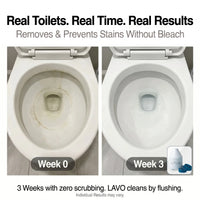
This is why treating the water continuously with a citric acid tank pod breaks the cycle before minerals have a chance to bond to porcelain. Rather than waiting for scale to harden and dissolving it after the fact, a pod sitting in the tank releases a steady, small dose of citric acid into the water with every refill. Calcium and magnesium ions stay chelated in dissolved form from the moment the tank fills, instead of getting the standing time they need to crystallize — which matters enormously more in a 20 GPG household than a 3 GPG one, since there's simply more mineral content that would otherwise be racing to bond with the porcelain.
For homeowners specifically dealing with very high mineral content, understanding your household's actual GPG number — most water utilities publish it, or a home test kit will tell you directly — helps calibrate expectations around how often even a well-treated tank needs a light check. This guide to hard water and toilet buildup covers how to find your local water hardness data and what it means for your routine.
What This Looks Like Day to Day
If you've been assuming your household is somehow worse at bathroom maintenance than everyone else, or that you're using the wrong brand of cleaner, it's worth reconsidering that assumption entirely. A 20 GPG household in Albuquerque fighting a ring every four days isn't a cleaning failure. It's a predictable outcome of local water chemistry meeting a cleaning method — bleach and scrubbing — that was never built to address the mineral load in the first place.
Once the water itself is treated continuously rather than the porcelain being attacked reactively after the fact, the frequency of visible buildup drops dramatically, even in genuinely hard water regions. You're not fighting your local water supply from scratch every single week. You're keeping the minerals it carries in a dissolved state before they ever get the chance to become somebody else's Saturday morning scrubbing session.