
Quick Answer: Bleach is not recommended for toilet tanks by most plumbers. While it won't cause immediate damage, continuous chlorine exposure degrades rubber tank components — the flapper, seals, and washers — leading to leaks and running water over time. Bleach also doesn't dissolve limescale and releases chlorine gas with every flush.
Walk into any plumbing forum — Reddit's r/Plumbing, HomeownersHub, Angi's community boards — and you'll find a consistent theme: plumbers see corroded tank internals constantly, and they overwhelmingly link it to bleach drop-in tablets.
Most homeowners don't know this because the correlation takes 12-18 months to manifest. By the time the flapper fails or the tank runs continuously, the original bleach tablets are long forgotten.
What Bleach Actually Does in Your Tank
Bleach (sodium hypochlorite) is an oxidizing agent. When it contacts organic matter — bacteria, mold, surface staining — it oxidizes and bleaches it. This is what produces the "clean" look.
The problem is that sodium hypochlorite also oxidizes rubber. And your toilet tank contains substantial rubber components that are critical to its function.
The flapper — the rubber seal that controls water release when you flush. In a tank with continuous bleach exposure, flappers become brittle, develop small cracks, and eventually fail to seal. The result: your toilet runs continuously, wasting thousands of gallons of water monthly and raising your water bill significantly.
Fill valve seals — the rubber gaskets inside your fill valve also degrade under bleach exposure. This causes inconsistent filling and, eventually, valve failure.
Tank-to-bowl gasket — the large rubber seal between tank and bowl. If this fails, water leaks onto your bathroom floor. Not an emergency, but an expensive repair.
Toilet manufacturers are aware of this. Several — including American Standard — have explicitly stated in their warranty documentation that bleach-based in-tank cleaners void the warranty on flapper components.
The Chlorine Fumes Issue
Every time you flush a toilet with bleach in the tank, the water agitation releases small amounts of chlorine gas (specifically hypochlorous acid vapor) into the bathroom air.
In an outdoor setting or large ventilated space, this amount is negligible. In a small, enclosed bathroom that you use daily — especially one where children play on the floor, or pets occasionally drink from the bowl — the cumulative exposure is worth considering.
This is the primary reason parents of young children or pet owners cite for switching away from bleach-based products. The concern isn't acute poisoning — it's the daily, low-level exposure that accumulates.
Why Bleach Doesn't Even Work on Limescale
Here's the most counterintuitive part: bleach doesn't solve the main visual problem most people are using it to address.
Toilet rings are made of calcium carbonate — an alkaline mineral. Bleach is also alkaline (pH 11-13). Alkaline compounds don't dissolve alkaline compounds.
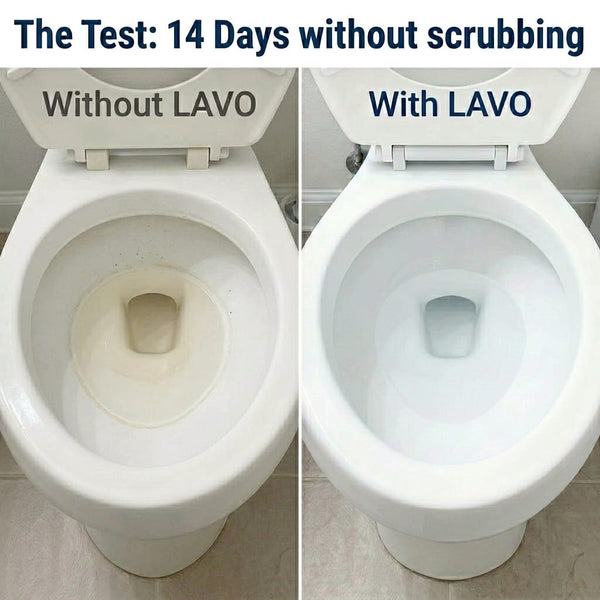
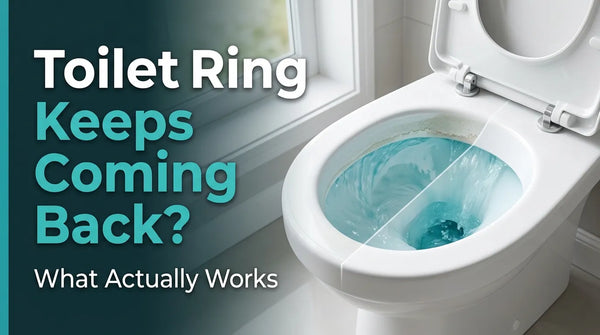
What bleach does is oxidize the brown and yellow pigmentation of the ring, making it appear lighter. The calcium mineral is still physically there, still adhering to the porcelain. Within 48-72 hours, new calcium deposits from subsequent flushes build on top, and the discoloration returns.
This is why people using bleach tablets clean their bowls every week for years without the problem ever being solved. They're repeatedly bleaching over the same calcium structure.
What Actually Dissolves Limescale
Citric acid. Specifically: the same compound found in lemons, used in every professional kettle descaler and limescale remover on the market.
Citric acid (pH 2-3) is acidic. Calcium carbonate is alkaline. Acid dissolves alkaline. The chemistry is straightforward and produces calcium citrate — a water-soluble compound that simply flushes away.
The practical difference: citric acid removes the calcium deposit. Bleach temporarily hides the calcium deposit.
The Safer Alternative
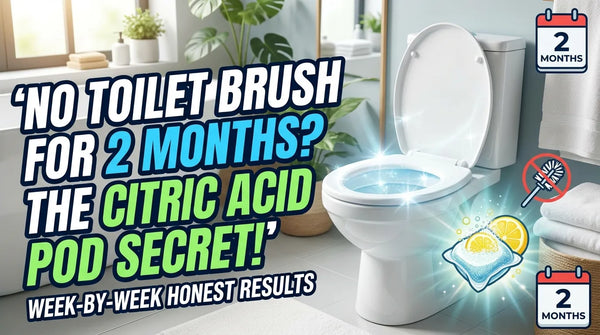
Dropping a citric acid pod into your tank instead of bleach creates continuous automatic cleaning with every flush — the same "set it and forget it" convenience, without the rubber degradation or chlorine exposure.
Citric acid is pH-safe for all tank materials. It's non-toxic at the concentrations present in toilet bowl water. It's biodegradable. And it actually works on limescale — not just on the color of limescale.
FAQ
Q: I've used bleach tablets for years with no issues. Should I still switch?
Rubber degradation is gradual and often not obvious until failure. If your toilet hasn't needed flapper or fill valve replacements, you may simply be ahead of the curve. Switching now prevents the eventual repair cost.
Q: Are there bleach tablets that are safe for rubber?
Some newer formulations claim reduced rubber impact. The chlorine fume and limescale ineffectiveness issues remain regardless of formulation.
Q: How long does the rubber damage take to show?
Typically 12-24 months of continuous use before functional failure becomes noticeable.
The bleach tablet has been the default automatic toilet cleaner for decades. That doesn't mean it's the right choice, it means it's the familiar one. Your plumber knows the difference.
LAVO uses citric acid — the professional descaler choice — in a reusable pod. No bleach. No rubber damage. Available at lavopure.com.