
Quick Answer: For limescale prevention, cleaning frequency should be determined by your water hardness — not a generic weekly schedule. In hard water areas (London, California, Texas), visible rings can form in 2-3 days, making weekly cleaning reactive rather than preventive. In soft water areas, fortnightly cleaning may be sufficient for appearance. Bacterial sanitation of the rim and seat should happen at least weekly regardless of water type.
"Clean your toilet once a week" is advice so universal it appears on virtually every cleaning schedule you'll find online. It's also advice that was generated without knowing anything about your water supply — which is the single most important variable in determining how often your toilet actually needs attention.
The Two Distinct Cleaning Goals
Toilet cleaning serves two separate purposes that are often conflated:
Sanitation — reducing bacterial and pathogen load on touch surfaces (seat, lid, rim, flush handle). This is a genuine hygiene concern, especially in multi-person households.
Limescale prevention — preventing mineral deposit accumulation in the bowl. This is primarily an aesthetic concern related to water chemistry.
These two goals have different optimal frequencies and are best addressed by different methods.
Sanitation Frequency — The Actual Science
For the sanitation goal, research suggests the following for a typical household:
• 1-2 person household: Weekly sanitizing of seat and rim is sufficient under normal circumstances
• 2-4 person household: Twice weekly for high-touch surfaces (seat, lid, flush handle) during cold and flu season; weekly otherwise
• 4+ person household or households with young children: Twice to three times weekly — higher traffic means higher bacterial load accumulation
The under-rim area — where flush jets are located — should receive attention monthly regardless of household size, as it's a warm, moist environment where biofilm forms readily but is rarely cleaned.
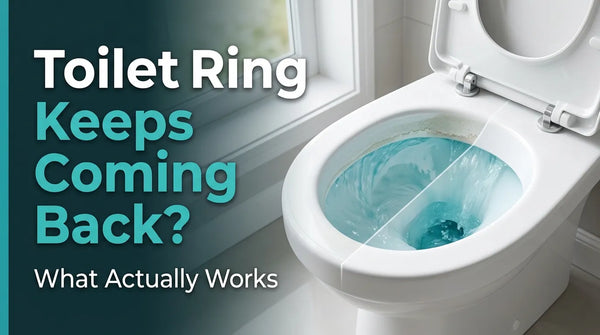
Limescale Frequency — It's Your Water, Not the Calendar
The limescale (ring) problem follows a completely different schedule determined by water hardness:
• Soft water (under 60 mg/L): Ring accumulation is slow. Fortnightly or even monthly bowl cleaning is often sufficient to prevent visible buildup.
• Moderately hard water (60-120 mg/L): Weekly cleaning generally keeps pace with accumulation.
• Hard water (120-180 mg/L): Weekly cleaning is reactive — the ring is already back before you clean. Twice weekly is needed to stay ahead. This is where most people feel like they're losing.
• Very hard water (over 180 mg/L): Even twice weekly cleaning may not prevent visible accumulation in some households. This is the "scrub Monday, ring back Wednesday" experience.
The hard water trap: People in very hard water areas who clean weekly aren't lazy or unhygienic. They're fighting a daily mineral deposition rate that a weekly cleaning schedule structurally cannot win against.
How to Need to Clean Less
The logical response to an impossible weekly schedule isn't to clean more often. It's to change the water chemistry.
When the water entering your bowl contains citric acid — from an automatic tank pod — the mineral deposition rate drops dramatically. Calcium can't accumulate because it's neutralized in the water before it reaches the bowl surface. The limescale cleaning task effectively disappears.
This shifts your remaining cleaning obligation to sanitation only — wiping the seat and rim — which takes 2-3 minutes with a disinfectant wipe. No scrubbing. No brush. No bowl cleaner.
Practical Schedule Based on Household Type
Solo or couple, soft water:
• Seat/lid/rim wipe: once weekly with disinfectant
• Bowl: wipe monthly or when needed
• Under rim: monthly with brush
• Tank pod: replace every 30 days
Family, moderately hard water:
• Seat/lid/rim wipe: twice weekly
• Bowl: weekly wipe only (if using tank treatment)
• Under rim: every 2-3 weeks
• Tank pod: replace every 30 days
Family, hard water:
• Seat/lid/rim wipe: 2-3x weekly
• Bowl: tank treatment eliminates scrubbing need
• Under rim: every 2-3 weeks with brush
• Tank pod: replace every 30 days
The Telling Question
If you're cleaning your toilet on a regular schedule and the bowl still has a visible ring when you start — you're behind the accumulation rate. That's not a frequency problem you can solve by cleaning more often.
It's a chemistry problem you solve by changing what's in the water.
FAQ
Q: Do I need to clean more often if someone is sick?
Yes. During a gastrointestinal illness, daily cleaning and disinfecting of all toilet surfaces (including the flush handle and surrounding surfaces) is recommended to prevent household spread.
Q: What if I have a toilet used by guests occasionally?
The sanitation concern is low for infrequent use. The limescale issue depends on water. A tank pod running continuously means a guest toilet stays clean between infrequent uses without any dedicated maintenance routine.
Q: Does the toilet need disinfecting or just cleaning?
For normal household use in a healthy household, cleaning (removing organic matter) is more important than disinfection. Hospital-level disinfection in a residential bathroom isn't necessary unless someone is immunocompromised.
The "once a week" rule is a useful default that fits many households. For millions of households in hard water areas, it represents a Sisyphean cleaning schedule that no amount of effort will ever make work.
LAVO changes the chemistry so the bowl stays clean between your sanitation wipes. Available at lavopure.com — try risk-free for 30 days.