
Quick Answer: Hard water contains dissolved calcium and magnesium that deposit on bathroom surfaces with every use — creating limescale rings, mineral scale on faucets, spotty glass, and cloudy showerheads. Soft water contains very little dissolved mineral and leaves far fewer deposits. About 85 percent of American households have moderately to very hard water. Understanding which you have changes everything about your cleaning approach.
What Hard Water and Soft Water Actually Are
Water hardness describes the concentration of dissolved minerals — primarily calcium carbonate and magnesium carbonate — in your water supply. These minerals enter groundwater naturally as it moves through limestone and chalk rock. They're harmless to drink. They are not harmless to bathroom surfaces.
Water hardness is measured in milligrams per liter (mg/L) of calcium carbonate: soft (under 60 mg/L), moderately hard (60 to 120 mg/L), hard (120 to 180 mg/L), and very hard (over 180 mg/L). Notable examples: London averages 294 mg/L, Phoenix 200+ mg/L, Las Vegas 250+ mg/L, Los Angeles 300+ mg/L. New York City, Seattle, and most of New England have relatively soft water.
What Hard Water Does to Your Bathroom
In the toilet: Calcium precipitates out of the water and bonds to porcelain at the waterline with every single flush. Over 2 to 4 days in a hard water area, a visible ring forms. In very hard water, the ring can appear within 24 to 48 hours.
On faucets and taps: White or brownish scale accumulates around the base and spout. Chrome finishes become dull under a layer of mineral film.
On shower glass: White cloudy spots or full mineral haze develop as water dries on the glass, leaving dissolved calcium behind.
In the showerhead: Mineral scale gradually blocks the jets, reducing water pressure and causing uneven spray patterns.
In the toilet tank: Calcium deposits on all internal surfaces and mechanical components, shortening their functional life.
What Soft Water Does to Your Bathroom
Soft water creates far fewer mineral deposits. Faucets stay cleaner longer, glass stays clearer, and the toilet ring forms slowly or not at all. However, soft water has its own characteristics: it tends to feel slippery due to the absence of dissolved minerals, soap lathers more readily (which can mean soap scum builds up if not rinsed well), and it has a slightly different taste.
Households with water softeners often notice that cleaning becomes much easier after installation. They also notice higher water bills for the salt-based softener maintenance and some concerns about sodium in drinking water.
How Water Hardness Changes Your Cleaning Approach
If you have hard water and clean your toilet with bleach products, you are in a loop that has no exit. Bleach doesn't dissolve calcium. The ring reforms as fast as you remove it because the water causing it is unchanged.
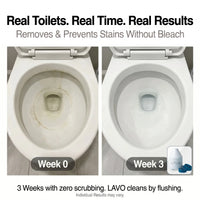
The effective intervention for hard water households is treating the water itself — not the surface it's deposited on. A continuous citric acid treatment in the tank neutralizes calcium ions as they arrive with every flush, before they can adhere to the porcelain. Households that switch from bleach-based automatic cleaners to citric acid systems often describe it as the end of a battle they had been fighting for years.
Frequently Asked Questions
How do I know if I have hard water?
Check for white scale around your faucets, spotty dishes from the dishwasher, soap that doesn't lather well, or a toilet ring that returns within a few days of cleaning. Your local water utility publishes annual water quality reports with exact hardness measurements.
Does a water filter help with hard water problems?
Standard pitcher or faucet filters improve taste and reduce certain contaminants but don't reduce water hardness (dissolved calcium and magnesium). You need a specific ion-exchange water softener or a point-of-use treatment for the toilet specifically.
Is soft water better for your pipes and appliances?
Yes. Soft water extends the life of appliances like dishwashers and washing machines, reduces scale in pipes, and eliminates the limescale problems in bathrooms. The trade-off is the cost and maintenance of a softening system.
If you live in a hard water area, you need chemistry that matches the problem. Citric acid is that chemistry. See it at www.lavopure.com