
You walk into your bathroom, lift the toilet lid, and see it: a slimy, pinkish-orange ring sitting right at the waterline. Maybe it's under the rim. Maybe you've also noticed it creeping into your shower grout or pooling around your sink drain.
Your first instinct is probably to assume it’s a water quality issue—maybe iron in your pipes, or some weird type of rust. When you realize it feels slimy, your second instinct is to assume it’s a dangerous form of pink mold.
It isn't mold. And it isn't rust.
Here is the truth about what is actually growing in your toilet bowl, whether you should be worried, and why the most common method people use to clean it is quietly destroying their plumbing.
The truth about "Pink Mold"
That pink slime has a name: Serratia marcescens.
It is an airborne bacteria, not a mold. It is naturally occurring, extremely common, and it is floating in the air in almost every environment. You cannot filter it out of your tap water, because it isn't coming from your tap water—it's coming from the air in your home.
Serratia marcescens thrives in environments that offer exactly three things:
-
Constant moisture
-
Warmth
-
Fatty substances (like soap scum, shampoo residue, or human waste) to feed on
Your bathroom is essentially a five-star resort for this bacteria. And the toilet bowl—which contains standing water 24 hours a day—is its favorite place to colonize. Once the bacteria settles on the wet porcelain, it rapidly multiplies, forming a biofilm. That biofilm is the pink or orange-pink ring you are looking at.
Is it dangerous?
For the average healthy adult, Serratia marcescens is mostly a gross nuisance rather than a severe health threat. Touching it won't instantly make you sick, and breathing near it isn't like breathing in toxic black mold spores.
However, it is not completely harmless.
In hospital settings, Serratia marcescens is a known pathogen. In a household, it can cause infections if it comes into contact with open wounds, or if it gets into the eyes (which is why you should never ignore pink slime growing around a contact lens case on your sink). For young children, the elderly, or immunocompromised individuals, it can occasionally lead to urinary tract or respiratory infections.
It is a bacteria. You do not want a colony of it sitting in the room where you brush your teeth.
Why you can't seem to get rid of it
This is where the frustration starts. You see the pink ring, you grab a toilet brush, you scrub it away, and the bowl looks perfectly white again.
Five days later, the pink ring is back.
This happens because brushing only removes the visible top layer of the colony. Biofilms are incredibly resilient. They anchor themselves into the microscopic pores of your porcelain. If you do not change the environment of the water, the airborne bacteria simply lands in the bowl the next day and starts the colonization process all over again.
The bleach trap (and why it costs you money)
When brushing fails, most people reach for the nuclear option: bleach.
They pour a cup of liquid bleach into the bowl, or worse, they buy heavy-duty blue bleach tablets and drop them directly into the toilet tank.
Does bleach kill Serratia marcescens? Yes. It is highly effective at destroying the bacteria in the bowl.
But if you use in-tank bleach tablets to fight pink stains, you are trading a bacterial problem for an expensive plumbing disaster.
Chlorine bleach is highly corrosive to rubber and soft plastics. Your toilet tank relies on a rubber flapper and multiple soft gaskets to seal water in. When you drop a bleach tablet into the tank, those rubber parts are submerged in highly concentrated chlorine 24/7. Within months, the chlorine chemically degrades the rubber. It becomes brittle, cracks, and begins to leak.
This is the number one cause of "running toilets." It wastes hundreds of gallons of water a month, and it is the exact reason why major toilet manufacturers state in their manuals that using in-tank drop-in tablets voids your toilet’s warranty.
You killed the pink ring, but you ruined a $400 toilet fixture to do it.
How to stop the pink stains safely
If you want to stop the pink bacteria from recolonizing, you have to treat the water continuously, but you have to do it with chemistry that doesn't melt your plumbing.
Instead of treating the bowl with harsh, rubber-destroying chlorine, the safest and most effective method is to alter the pH of the water using a mild, natural acid.
This is exactly what citric acid does.
When your toilet bowl water is continuously treated with a steady, low-dose of citric acid, the environment becomes hostile to bacterial colonization. Serratia marcescens struggles to anchor and build a biofilm in an acidic environment. Furthermore, citric acid breaks down the hard-water mineral scaling (calcium) that bacteria often cling to for survival.
The set-it-and-forget-it solution
If you are tired of scrubbing pink slime every week, you need a system that treats the water before it ever enters the bowl.
LAVO was designed specifically to solve this problem without voiding your plumbing warranty.
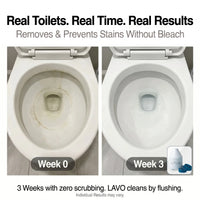
The LAVO pod sits safely in your toilet tank. Instead of bleach, it uses a controlled-release citric acid formula. Every time you flush, it sends a perfectly measured dose of citric acid into the bowl. It prevents the pink bacterial biofilm from forming, it dissolves hard water limescale, and it is 100% safe for your rubber flapper, your gaskets, and your septic system.
Stop scrubbing the same pink ring week after week, and stop sacrificing your plumbing to harsh bleach tablets.
See how the LAVO continuous citric acid system works now. Click the Button & Profit from our Limited Time Sale!