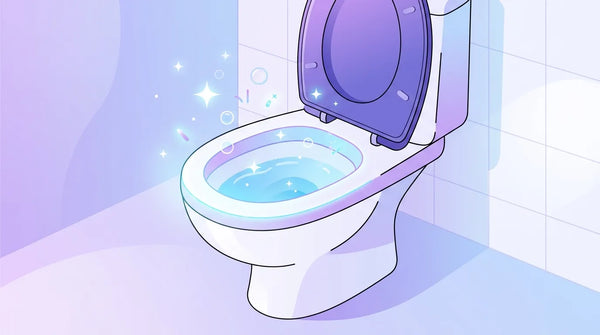


It's 9:47 PM on a Tuesday, you've got a 7 AM meeting, and you're on your knees next to the toilet with a scrub brush because you noticed the ring an hour ago and it's been bothering you ever since. This isn't dirty-house behavior. This is the specific, low-grade exhaustion of knowing a ten-minute task exists and having to keep finding ten minutes for it, week after week, for the rest of your life.
Most people never actually add up what bathroom maintenance costs them in hours. They just feel the drag of it — the mental note that never goes away, the "I'll do it Saturday" that becomes "I'll do it next Saturday." So let's actually do the math, and then look at where that time is really going, because most of it isn't going where you think.
The Time Nobody Accounts For
Ask someone how long they spend cleaning their bathroom and they'll usually estimate the big Saturday scrub — fifteen, twenty minutes, tops. That's not the real number. The real number includes the five-minute "quick wipe" before guests show up unannounced, the emergency scrub when the ring gets embarrassing, the tank lid you occasionally pop open because something smells off, and the mental overhead of just knowing it needs doing. Most cleaning-habit surveys put total bathroom upkeep somewhere around two hours a week per household when you count all of it, not just the scheduled deep clean. Over a year, that's more than 100 hours — roughly two and a half work weeks — spent on a single room in your house.
Here's the part that actually matters for a busy household: most of that time isn't going toward keeping things clean. It's going toward re-solving the same problem over and over, because the underlying cause never got addressed in the first place.
Why You're Cleaning the Same Ring Every Week
The toilet ring you're scrubbing on Tuesday isn't new dirt. It's mineral scale — dissolved calcium and magnesium that gets left behind every time water evaporates off the waterline. As those minerals concentrate, they crystallize into rough deposits that bond directly into the microscopic pores of aged porcelain. Older toilets have rougher, more porous surfaces than new ones, which means the scale has more to grab onto every single cycle.
This is the actual reason a clean bowl doesn't stay clean. The ring keeps coming back because that mineral base layer never fully leaves — you're wiping away the surface grime that sticks to it, not the scaffolding underneath. So the ten minutes you spend this week doesn't actually save you ten minutes next week. It just resets the visible symptom while the cause keeps building.
The Bleach Detour
A lot of people reach for bleach here because it's fast and it's what's under the sink. The problem is what bleach actually does chemically: it oxidizes organic pigment, which makes stains look whiter. That's the whole mechanism. It doesn't touch mineral scale at all. So you get a bowl that looks clean for a day or two, sitting on the exact same jagged mineral texture — which then grabs new grime within about 48 hours. You didn't fix anything. You just spent time making it look fixed.
Citric acid does something bleach can't: it chelates, meaning it chemically binds to calcium and magnesium ions and converts them into water-soluble citrates. Those rinse away with a normal flush instead of needing to be scraped off. It's a weak organic acid, the same family of chemistry that makes lemon juice cut through hard water spots on glassware — just applied where the buildup actually starts.
The Three Places Your Time Actually Goes
Break down a typical month of bathroom upkeep and it sorts into three categories, and only one of them is unavoidable.
- Reactive scrubbing — the emergency ten minutes when the ring gets bad enough to notice. This is the biggest time sink for most households, and it's entirely a function of how much scale has built up since the last clean.
- Preventive habits — quick wipes, keeping the fan running, closing the lid before flushing. These take almost no time individually but add up if you're doing them daily out of anxiety rather than actual need.
- The deep clean — tank, base, grout, the stuff that genuinely needs a scheduled pass. This is the one category that's actually necessary and worth the time.
Most people spend 70 to 80 percent of their bathroom-cleaning time in the first category — the reactive kind. Which means the fastest way to get real hours back isn't cleaning faster. It's shrinking how much scale builds up between cleanings, so there's less to react to in the first place.
Systems Beat Effort
If you've ever tried to fix this by just "being more consistent" — cleaning every three days instead of waiting for it to get bad — you already know the problem. Consistency requires remembering, and remembering is its own kind of tax on a busy week. The households that actually get their time back usually aren't the ones who scrub harder. They're the ones who removed a step entirely.
This is where treating the water passively, instead of reactively, changes the math. A continuous citric acid tank pod sits in the tank and releases a small, steady dose of the same acid that dissolves mineral scale, with every single flush. Because the water is being treated constantly instead of once a week during a scrub session, minerals don't get the uninterrupted evaporation-and-concentration cycle they need to bond into the porcelain in the first place. This is why treating the water continuously with a citric acid tank pod breaks the cycle before minerals have a chance to bond to porcelain — the reactive scrubbing category, the one eating most of your time, just gets smaller because there's less buildup to react to.
It's not a replacement for occasionally wiping down the base or running the fan. Those preventive habits still matter and still take almost no time. But it does take the biggest, most unpredictable time sink — the emergency scrub — and shrinks it down to something closer to a quick glance rather than a kneeling-on-the-floor event.
What This Looks Like for an Actual Busy Week
For a working parent or anyone juggling a full schedule, the real win isn't a shorter Saturday cleaning session. It's not having a Tuesday night where you're on the floor at 9:47 PM because the ring finally crossed some threshold in your head. It's the removal of an unscheduled task from a week that didn't have room for one.
If you're already rethinking how your whole bathroom routine is ordered — not just the toilet, but the sink, the shower, the floor — doing the tasks in the right sequence saves real time on its own, since cleaning surfaces in the wrong order just means redoing work you already finished. And if your water is on the harder side, which speeds up every part of this mineral cycle, hard water is quietly adding hours to your yearly cleaning total without you realizing it.
None of this requires an overhaul. It requires figuring out which part of the process is actually taking your time — and it's almost never the deep clean. It's the reactive scrubbing you didn't schedule, for a problem that started building the moment the last clean finished. Fix the source, and the calendar space you get back is bigger than it looks on paper.