
Kneeling on a cold tile floor with your head practically inside a toilet bowl is not anyone's idea of a good afternoon. If your knees complain the second you lower yourself down, or your lower back locks up halfway through, or you've had a hip replacement and bending over a low rim just isn't happening the way it used to, you already know this task stopped being "just cleaning" a while ago. It became something you dread, then something you put off, then something that quietly embarrasses you when you can't get to it.
Here's the thing nobody says out loud enough: needing an easier way to keep a bathroom clean isn't a failure of effort. It's a mechanical problem — your body isn't built for the position this chore demands, and honestly, it never really was. The good news is the actual chemistry behind toilet cleaning has almost nothing to do with elbow grease. Once you understand what's actually happening in that bowl, you can solve most of it without getting anywhere near the floor.
Why This Chore Specifically Punishes Your Body
Standard toilet cleaning asks you to do the one combination of movements that's hardest on aging joints: bend forward, rotate at the hips, apply downward pressure with your arm extended, and hold that position for several minutes. If you've got arthritis in your hands, that grip-and-scrub motion on a brush handle is its own problem. If your knees or back are the issue, just getting down to the right height — and back up again — can be the most physically demanding part of your whole day.
None of that has anything to do with how clean the bowl actually gets. It's just the way the task has always been done, by default, because nobody designed it for people who can't get low. That's worth sitting with for a second: the method is the problem, not you.
What's Actually Causing the Mess You're Scrubbing
Before finding an easier way, it helps to know what you're up against, because the answer isn't "dirt" in the way most people think about it.
The ring at the waterline forms because water is constantly evaporating off the surface, and every time it does, it leaves behind dissolved calcium and magnesium. Over weeks, those minerals concentrate into rough micro-crystals that bond into the microscopic pores of aging porcelain. Older toilets have more of these pores, which is part of why the ring seems to come back faster the older the fixture gets. This is also the exact reason the ring keeps reappearing no matter how hard anyone scrubs it away — the mineral base layer underneath never actually left, so it just grows back.
Then there's the tank, which almost nobody thinks about, let alone scrubs. It holds still water at room temperature for weeks at a time, which happens to be close to ideal conditions for bacterial growth — including Serratia marcescens, the bacteria behind that pink or orange film some people notice near the waterline. It's airborne and common in humid bathrooms, and no amount of bowl scrubbing touches it, because it's happening somewhere you're not reaching.
Why Bleach Isn't the Answer Either
A lot of people lean on bleach specifically because it feels like less physical effort — pour it in, wait, flush. Here's the problem: bleach oxidizes organic pigment, which is what makes stains look whiter. It does absolutely nothing to dissolve mineral scale. So the ring looks gone for a day or two, sitting on the exact same rough mineral texture, which then grabs new grime within about 48 hours. You still end up back on the floor, just a little later than you'd hoped.
Citric acid works on a completely different mechanism. It's a mild organic acid that chelates — chemically binds to — calcium and magnesium ions, converting them into water-soluble citrates that rinse away with a normal flush. No pressure, no scrubbing motion required for it to do its job. It's the same basic chemistry that lets lemon juice cut through hard water spots on a glass, just concentrated and given time to work.
A Cleaning Approach That Doesn't Require Kneeling
The goal here isn't to power through the pain with better tools. It's to remove the bending and scrubbing from the process almost entirely.
- Use a long-handled toilet brush or wand — one long enough that you can clean standing upright, or seated on a shower chair positioned beside the toilet, without bending your spine forward.
- Apply a citric acid or descaling treatment and simply let it sit — pour it in, close the lid, and walk away for 30 to 60 minutes. The chemistry does the dissolving while you're doing literally anything else.
- Flush instead of scrub — once the acid has had time to work on the mineral bonds, a normal flush clears most of what's left, cutting the physical scrubbing down to a light pass instead of a full workout.
- Handle the base and floor with a mop, not a rag on your knees — a flat mop with a removable, washable head reaches the base of the toilet without requiring you to get down to it.
If mobility is a bigger concern than just the toilet itself, the same logic — treat chemically first, minimize physical contact second — applies to the rest of the room. Doing tasks in the right order also cuts down on repeated effort, since tackling surfaces out of sequence often means redoing work you already did.
Removing the Task Before It Starts
The approach above cuts the physical demand way down. But there's a version of this that goes further, because the real long-term fix isn't a better technique for an occasional deep clean — it's reducing how much scale builds up between cleanings in the first place.
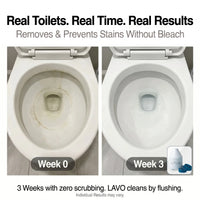
Think of it this way: the ring you're dealing with today is the result of weeks of untreated water sitting and evaporating, cycle after cycle. Treating the water once a week, even efficiently, still lets scale build the other six days. A continuous citric acid tank pod changes that timeline. It sits in the tank and releases a steady, low dose of the same acid with every flush, so the water is being treated constantly instead of periodically. This is why treating the water continuously with a citric acid tank pod breaks the cycle before minerals have a chance to bond to porcelain — there's simply less scale accumulating for anyone to deal with, physically or otherwise, by the time you'd normally notice it.
For someone managing joint pain or limited mobility, that's the difference between an occasional light flush-and-check and a recurring physical ordeal. It doesn't eliminate the need to ever touch the toilet again — the base, the seat hinges, and the floor still benefit from the standing-mop routine above. But it takes the single hardest part of this chore, the ring at the waterline, and makes it mostly a non-issue.
You're Not Failing at This
If you've felt guilty about a bathroom that isn't as spotless as it used to be, or you've been quietly avoiding having certain people over because of it, that guilt is misplaced. The task was designed around a body position a lot of people simply can't hold anymore, and there was never a rule that said cleaning has to hurt. Even in situations where you don't control the fixtures themselves, the water treatment side of this is something you can manage entirely on your own terms.
Independence in your own home matters, and for a lot of people, this one chore has been quietly chipping away at that. Changing the method — chemistry first, standing tools second, less bending overall — puts that independence back where it belongs, without asking your knees or your back to pay for it.