
Quick Answer: The best toilet cleaner for hard water is citric acid — applied continuously with every flush. Bleach and most commercial cleaners don't dissolve calcium carbonate (limescale). Citric acid does. For hard water households, continuous automatic application is the only method that keeps pace with constant mineral deposition.
If you've ever noticed white scale around your kettle base, mineral crust on your shower head, or a rainbow of staining in your toilet bowl — you have hard water. And your cleaning routine is probably costing you far more time and effort than it should, because the products you're using don't match the chemistry of the problem.
What Hard Water Actually Is
Tap water is never pure H2O. As it travels through ground and rock, it dissolves minerals — primarily calcium carbonate and magnesium carbonate. The more minerals dissolved, the "harder" the water.
Hardness is measured in milligrams per liter (mg/L) or grains per gallon (GPG):
• Soft: Under 60 mg/L
• Moderately hard: 60-120 mg/L
• Hard: 120-180 mg/L
• Very hard: Over 180 mg/L
The following areas have notably hard water: most of Southeast England (London averages 294 mg/L), East Anglia, the Midlands, California, Texas, Arizona, Nevada, and Florida. If you live in these regions, your toilet is receiving a calcium deposit with every single flush — 10 to 20 times per day.
What Hard Water Does to a Toilet Over Time
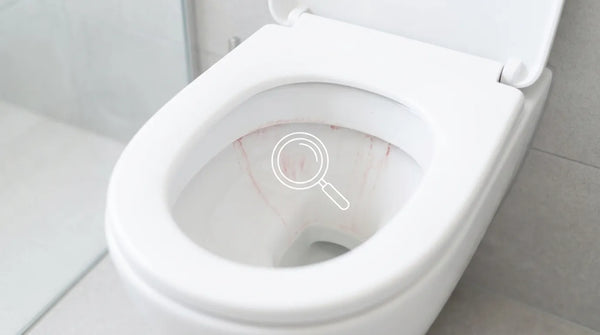
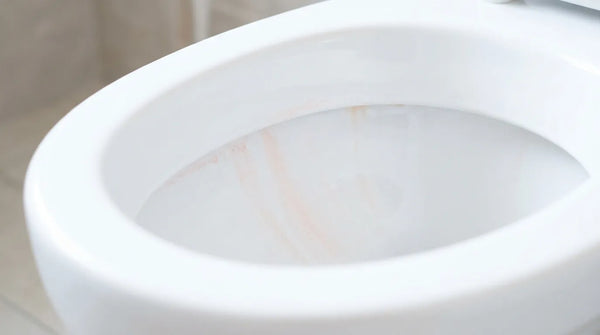
The immediate visible effect is limescale: the brown, rust-colored ring at the waterline and deposits inside the tank.
But hard water damage extends further:
Porcelain etching: Over years, mineral accumulation and the aggressive cleaners people use to fight it can etch the porcelain surface, creating microscopic grooves where bacteria and future deposits accumulate faster.
Tank component damage: Calcium buildup on the fill valve, flapper, and float mechanisms reduces their accuracy and lifespan. A heavily calcified fill valve overfills or underfills — both waste water.
Pipe narrowing: In homes with very hard water, pipe interiors accumulate scale over years, gradually reducing water pressure and flow.
Aesthetic degradation: Porcelain that was bright white becomes progressively more difficult to clean as mineral deposits form a base layer that future deposits adhere to more easily.
Why Most Cleaners Fail on Hard Water
The mainstream toilet cleaning products — bleach gels, in-tank bleach tablets, drop-in "color changers" — are formulated primarily as disinfectants and deodorizers. Their active ingredient is sodium hypochlorite (bleach), which is excellent at killing bacteria and oxidizing organic stains.
Limescale is not organic. It's not bacteria. Bleach has no chemical mechanism to dissolve calcium carbonate. What it does is bleach the pigment of the limescale white, creating the illusion of removal while the mineral structure remains intact and continues accumulating.
This is why hard water households can scrub weekly with commercial cleaners and still have an orange ring by the following weekend. The cleaner is treating the color, not the calcium.
The Chemistry That Actually Works
Citric acid (and to a lesser extent phosphoric acid, found in some professional descalers) reacts directly with calcium carbonate in a chemical process called acid-base neutralization. The products of this reaction — calcium citrate and CO2 — are water-soluble and simply flush away.
This is not a cleaning effect. It's a chemical dissolution. The calcium is gone — not hidden, not bleached, gone.
Every kettle descaler tablet works on this principle. Every professional limescale remover. Every "anti-lime" product. They all use acid because acid is the only chemistry that works on calcium carbonate.
Why Continuous Application Matters More in Hard Water Areas
For soft water households, an occasional citric acid treatment might be sufficient — their deposition rate is slow enough that periodic intervention keeps up.
For hard water households, the math is different. At 294 mg/L (London tap water) with 12 daily flushes, a toilet receives significant calcium input every single day. A once-weekly manual clean is always starting from behind.
Continuous automatic application — where every flush water contains a small amount of citric acid — neutralizes calcium as fast as it's deposited. The bowl never accumulates enough mineral for a visible ring because the chemistry intercepts it in real time.
Identifying Your Water Hardness
You don't need a test kit. Simply look for:
• White or orange mineral crust around any tap
• White residue inside your kettle
• Water that feels "slippery" compared to bottled water
• Any visible ring in the toilet bowl within a week of thorough cleaning
Your local water utility is also required to publish an annual water quality report that includes hardness measurements for your area.
FAQ
Q: Will a water softener fix the toilet problem?
Whole-home water softeners replace calcium ions with sodium ions. This prevents limescale but introduces sodium into drinking water (a health concern for some) and adds significant installation cost. A tank pod is a targeted, low-cost solution for the specific toilet problem.
Q: Do water softener tablets in the tank work?
These contain sodium compounds that modify water chemistry similarly to a whole-home softener. They're more effective than bleach but less targeted than citric acid for existing limescale removal.
Q: How quickly will I see improvement?
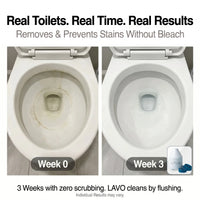
In hard water areas, visible blue water typically appears within 2-3 flushes of installing a citric acid pod. Existing limescale begins dissolving within 48-72 hours. A heavy ring may take 2-3 weeks to fully dissolve.
Hard water is not something you clean around. It's something you chemically address. Everything else is temporary.
LAVO is specifically designed for hard water homes. Citric acid applied with every flush. Available at lavopure.com.