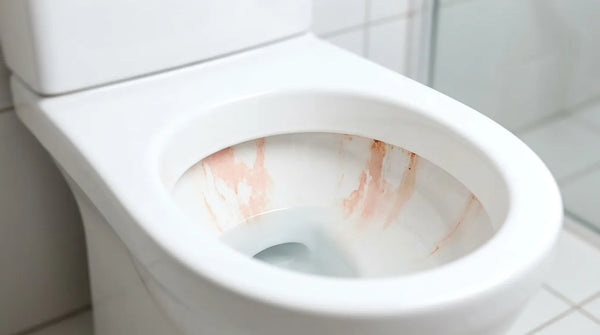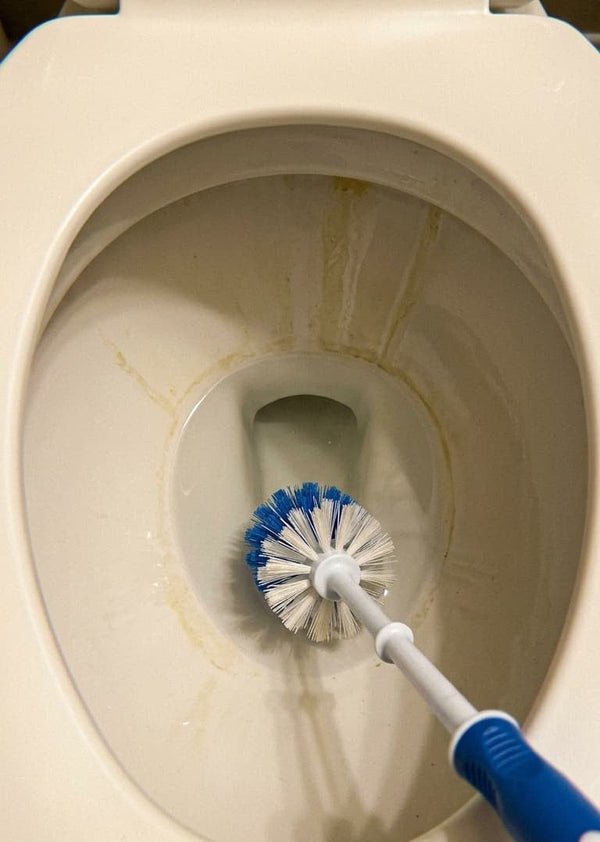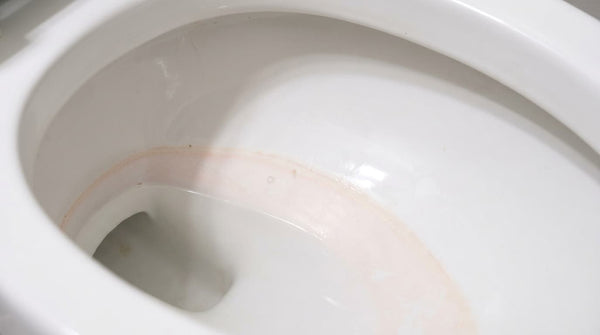

You just got a new toilet. Six months in, it looks like it belongs in an abandoned petrol station. Brown ring under the rim, streaks down the bowl, and nothing — not Bar Keepers Friend, not Vim, not Lysol, not even that viral Coca-Cola trick — has made it go away for longer than a few days. You tried them all. The ring still came back by Thursday.
Here is the truth: you're not cleaning it wrong. The problem isn't even the toilet.
It's Not Dirt, It's Your Water!
That brown staining you see isn't grime building up because the toilet isn't being cleaned often enough. It's mineralised water leaving deposits on the porcelain every single time you flush.
When water evaporates or settles between flushes, it leaves behind trace amounts of calcium, magnesium, iron, and manganese. Over time, those minerals bond to the ceramic surface, trap bacteria, and turn that off-white chalky residue into the brown, rust-coloured staining you're looking at right now.
This is called hard water damage — and the reason it showed up in your new toilet but not your old one is simply that the old toilet had years of wear and existing coating built up. Fresh, uncoated porcelain absorbs those mineral deposits faster and more visibly.
In the UK, large parts of England — particularly the south and east — have some of the hardest water in Europe. If you're in one of those areas, this is almost certainly what's happening.
Why Bleach, Bar Keepers Friend and Scrubbing Don't Fix It
This is the part that most cleaning advice gets wrong.
Bleach is a disinfectant. It kills bacteria on contact, which is why the toilet looks clean right after you use it. But it does absolutely nothing to dissolve or remove the mineral deposits causing the staining. In fact, bleach can react with iron in hard water and actually deepen the brown colour over time.
Scrubbing with a brush physically abrades the stain — temporarily. But because the minerals in your water are depositing with every single flush, the stain starts rebuilding the moment you put the brush away.
Bar Keepers Friend, Vim, and similar abrasive cleaners work on a similar principle. They can shift the surface layer, but they're fighting the water, not solving it.
What About the Popular Home Remedies?
Every cleaning community has a go-to toilet stain remedy doing the rounds. Here's an honest look at what actually works, and what doesn't:
Borax (and Borax + Vinegar)
This is one of the more effective DIY options. Borax is mildly alkaline, and when combined with white vinegar it creates a reaction that can break down limescale deposits. Pouring a quarter cup of borax into the bowl, swishing it, adding a cup of vinegar and leaving it for 20–30 minutes before scrubbing does genuinely shift mild to moderate hard water staining.
The catch: it still only removes what's already there. It doesn't prevent the minerals from redepositing after the next flush.
Coca-Cola
Coca-Cola contains phosphoric acid, which can dissolve light mineral buildup if left in the bowl for several hours. It works — occasionally, on mild staining. But the sugar content leaves its own residue, and the acid concentration is far too low to deal with serious hard water deposits. Think of it as a party trick, not a solution.
Dishwasher Pods (any brand)
Dishwasher tablets and pods contain enzymes, surfactants, and sometimes citric acid, all of which can help loosen mineral deposits in the bowl. Drop one in, let it dissolve for 30 minutes, then scrub. It can work on moderate staining.
Again, it treats the symptom — the existing stain — not the ongoing mineral deposits being introduced with every flush.
Lysol (Black Bottled)
The black bottle Lysol (and similar strong toilet cleaners) uses hydrochloric acid as its active ingredient. That is genuinely effective at dissolving limescale and mineral deposits, and it's what most professional cleaners use for a deep clean. Leave it under the rim, let it run down the bowl, and wait at least 30 minutes before scrubbing.
But hydrochloric acid is harsh on older pipes, harmful if mixed with bleach, and — you guessed it — still doesn't stop the minerals from coming back.
The Real Fix: Treat the Water, Not the Bowl
Every method above does the same thing: it reacts to staining that has already happened. The moment you flush, mineral-laden water re-enters the bowl and the cycle starts again.
The only way to stop the brown ring from coming back is to treat the water in the tank, before it ever touches the porcelain.
This is what professional plumbers actually recommend, and it's surprisingly simple. A descaling pod placed inside the toilet tank releases a small amount of descaling agent with every flush. Instead of hard mineral water hitting the bowl, each flush delivers treated water that can't bind to the surface or build up into staining.
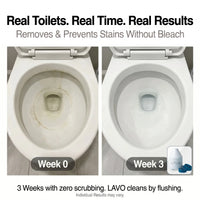
LAVO works exactly this way. It's a compact pod that sits inside your toilet tank and lasts around three months. Each flush releases a measured amount of citric acid-based descaler, meaning the water flowing into your bowl is treated before it arrives. No minerals depositing. No brown ring forming. No scrubbing.
It takes about ten seconds to install — open the tank lid, drop the pod in, close the lid. That's it.
It contains no bleach, no harsh chemicals, and is safe for septic systems and all standard pipes.
Why Your New Toilet Is More Vulnerable Than Your Old One
It's worth understanding why this often becomes a problem with new toilets specifically.
Fresh, unglazed or lightly glazed porcelain has a slightly more porous surface than older porcelain that has built up layers of mineral coating over years of use. That means mineral deposits grip to the surface faster and more visibly in the first months of use. Once the staining has a foothold, it compounds quickly — each layer of minerals gives the next layer something to bind to.
This is why you might look at someone else's ten-year-old toilet and wonder why it looks cleaner than your six-month-old one. Their bowl has essentially been sealed by years of mineral deposits that, paradoxically, now prevent new ones from gripping as hard.
Getting ahead of the problem early — treating the water at source from the start — is far easier than trying to remove embedded staining later.
What to Do Right Now
If you're already dealing with visible staining, here's a practical two-step approach:
Step 1 — Deep clean once to remove existing deposits. Use either a citric acid cleaner, a borax and vinegar combination, or a professional limescale remover like Harpic Black (which contains hydrochloric acid). Apply, leave for at least 30 minutes, scrub, repeat if necessary. This clears the slate.
Step 2 — Prevent it from returning. Drop a LAVO tank pod into your toilet tank. From that point on, every flush treats the incoming water, and the minerals that caused your staining problem in the first place no longer have a chance to settle on the porcelain.
You won't need to scrub again. You won't need to Google another home remedy. And in six months' time, your new toilet will still look new.
The Short Answer
Your toilet has brown stains because your water is hard and contains minerals that deposit on the bowl with every flush. Bleach doesn't fix it. Scrubbing doesn't fix it. Dishwasher pods, borax, and Coca-Cola treat the staining after it happens but can't stop it returning.
The fix is treating the water before it reaches the bowl — every single flush.