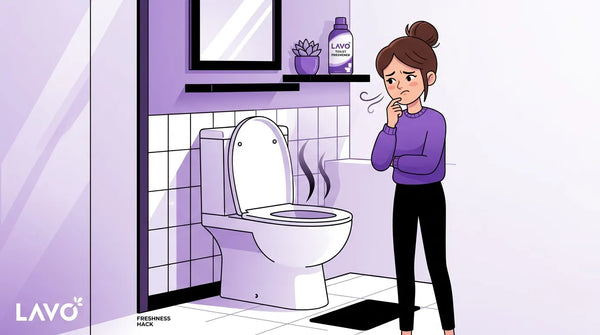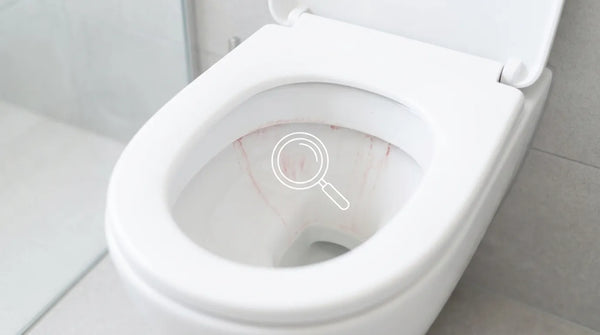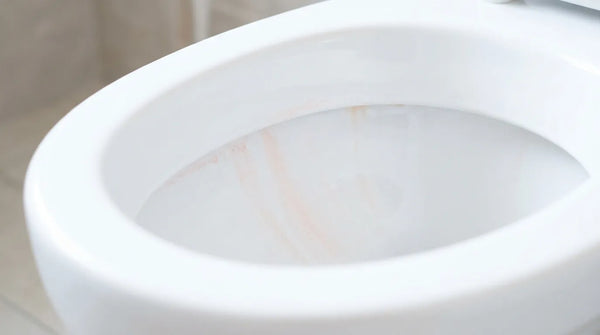

You clean your toilet regularly, and yet there's this orange, almost rust-colored ring that keeps showing up, usually right at the waterline or streaking down from under the rim. It doesn't look like a normal stain. It looks like something is actually rusting.
Good news: it's not your toilet rusting. Porcelain doesn't rust. What you're seeing is almost always iron in your water supply.
What causes the orange color
Most home water contains small amounts of dissolved minerals. If your water has a higher iron content, that iron oxidizes when it's exposed to air, the same basic chemistry as rust forming on metal. That oxidized iron settles wherever water sits and evaporates repeatedly, which is exactly what happens at your toilet's waterline.
This is common in homes with well water, older municipal pipes, or naturally iron-rich groundwater. If you've also noticed orange or reddish staining in your bathtub, sink, or on laundry, that's the same cause showing up in multiple places.
Is it dangerous?
No.
Iron in tap water at typical household levels isn't a health concern. It's a cosmetic and cleaning nuisance, not a safety issue. That said, if the staining appeared suddenly and is unusually heavy, it's worth a quick check with your water utility or a well water test, since iron levels can shift with seasonal changes or nearby plumbing work.
Why regular cleaning doesn't remove it
This is the part that frustrates most people.
You scrub, it fades a little, and it's back within days. That's because iron staining, like calcium-based limescale, isn't surface dirt. It's a mineral deposit bonding to the porcelain itself.
Standard bleach-based cleaners are especially weak here. Bleach is built to disinfect and whiten organic staining, not to break down mineral deposits. Scrubbing alone just polishes the surface while the deposit underneath stays intact and keeps darkening with each new exposure to iron-rich water.
What actually works on orange and rust stains
Acid-based cleaning is the right approach, the same logic that works on calcium-based limescale.
Citric acid and similar mild acids react with iron deposits and help break them down instead of just bleaching the color on top.
For a manual approach: an acid-based bowl cleaner or a citric acid soak, left to sit for 20 to 30 minutes before scrubbing, will do far more than a standard blue tablet. For stubborn buildup that's been there for months, you may need to repeat the treatment a few times.
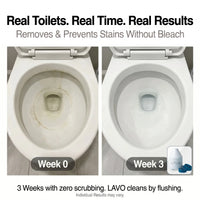
For ongoing prevention: since the iron in your water isn't going away on its own, a one-time clean will only buy you a few weeks before the ring returns. A continuous citric acid treatment in the tank keeps working with every flush, which is a much better match for a mineral problem that's constantly being reintroduced by your water supply.
Orange stains vs. other toilet stain colors
It helps to know what you're actually dealing with:
-
Orange or rust — iron in the water supply
-
Pink — usually bacteria (Serratia marcescens) feeding on moisture and residue
-
Brown — often a mix of hard water minerals and organic buildup
-
Black — typically mold or mineral buildup combined with moisture
Each of these needs a slightly different approach, but iron and hard water minerals both respond best to acid-based cleaning rather than bleach.
The bigger picture
If your toilet has an orange ring, a citric acid approach doesn't just fade the color, it addresses the actual mineral deposit causing it. And since the same water causing your orange stains is often also hard on your tank components and prone to leaving the classic waterline ring, a continuous treatment tends to solve more than one problem at once.
If iron and hard water keep winning the battle in your bathroom, see how a fully automated citric acid system works through clicking the button below!