
Quick Answer: The toilet ring returns because your cleaning method only removes visible buildup — it doesn't stop your water from depositing new calcium with every single flush. Within 48-72 hours of cleaning, the water has already started re-depositing the same minerals in the same place. You're resetting the cycle, not ending it.
This is one of the most common and most frustrating cleaning problems in any household. And the frustrating part isn't the cleaning — it's the futility of it. You know before you even finish that it's coming back.
The reason nobody in your life explained this to you is that most people don't understand the chemistry. Once you do, the solution becomes obvious.
Where the Ring Actually Comes From
Your toilet bowl water comes from the tank — fresh from your household water supply. Tap water, even in cities with good water treatment, contains dissolved minerals. Primarily: calcium carbonate and magnesium carbonate. These are completely harmless to drink. They're not so harmless to your porcelain.
When water meets the porcelain at the waterline — the spot where water sits between flushes — it undergoes a process called mineral precipitation. The dissolved calcium crystallizes out of solution and adheres to the porcelain surface. You can't see a single deposit. But each flush adds another layer. And after 48-72 hours of this constant deposition, the accumulated layers become visible as the familiar brown ring.
This is why the ring appears at the waterline specifically. It's not random. It's the exact point where water sits between flushes, continuously depositing.
Why Scrubbing Doesn't Work Long-Term
When you scrub the ring off, you remove the accumulated calcium physically. The porcelain underneath is clean — for a few hours. Then the next flush begins the deposition process again.
The rate of accumulation depends almost entirely on your water hardness — how much dissolved calcium your water supply contains. In areas like London, Southeast England, California, Texas, and Arizona, water hardness can exceed 200mg/L of calcium carbonate. In these areas, the ring can return visibly within 2-3 days. In soft water areas, it might take a week or more.
Neither population is cleaning more or less diligently than the other. The difference is purely their water supply.
The Bleach Explanation
Many people try bleach tablets or bleach-based toilet cleaners hoping they'll prevent the ring. They don't — for a specific chemical reason.
Bleach (sodium hypochlorite) is alkaline, with a pH around 11-13. Calcium carbonate is also alkaline. Alkaline compounds do not react with alkaline compounds in a way that dissolves them.
What bleach does is oxidize the pigmentation of the ring — the brown and yellow color — making it appear lighter or white. This is often mistaken for the ring being "gone." What's actually happened is the calcium structure is still there, now bleached white so it blends with the porcelain. Within days, new calcium deposits on top of the existing (now invisible) calcium, and the discoloration returns.
People using bleach tablets can spend years in this cycle, cleaning more frequently, using stronger products, achieving nothing because the chemistry doesn't support the goal.
What Actually Stops the Ring
The only chemistry that dissolves calcium carbonate is acid. Specifically: citric acid, the compound found in lemons and every professional descaler on the market. When citric acid contacts calcium carbonate, it reacts chemically to form calcium citrate — a water-soluble compound that flushes away. The mineral is gone, not bleached.
The breakthrough insight: if you apply this chemistry continuously — with every flush — calcium never accumulates. The tank water becomes slightly acidic, which neutralizes mineral deposits as fast as they form.
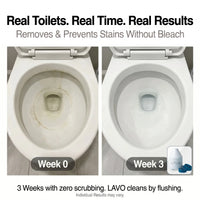
This is the mechanism behind automatic citric acid tank pods. They don't clean the ring once, they prevent the ring from forming by treating the water at its source before it ever reaches the bowl.
Hard Water: A Special Case
If your ring returns within 2-3 days, you almost certainly have hard water. You can confirm this by:
• Checking your local water utility's annual water quality report (most publish water hardness)
• The presence of white scale on your kettle, shower head, or tap fixtures
• Water that feels "slippery" or leaves white residue when dried
In hard water conditions, continuous treatment isn't optional — it's the only method that keeps pace with the constant mineral input. Manual cleaning will always be a losing battle when your water contains 200mg/L of calcium and you're flushing 10-15 times daily.
The Math on Manual Cleaning vs. Automatic
At 12 flushes per day and 200mg/L water hardness, your toilet deposits approximately 0.5-1g of calcium carbonate onto the bowl per day. Over 3 days: 1.5-3g. Over a week: 3.5-7g. This is what you're scrubbing off each time.
An automatic citric acid system prevents roughly 95% of this deposition by neutralizing calcium before it precipitates. The remaining 5% is too diffuse to form a visible ring.
The ring stops coming back because the deposition stops happening — not because the cleaning gets better.
LAVO's citric acid pod sits in your tank and treats the water with every flush. No scrubbing, no ring. Available at lavopure.com — 30-day money-back guarantee.