
Quick answer: the best toilet cleaner for hard water contains an acid — citric acid, lactic acid, or hydrochloric acid. These react chemically with calcium carbonate (limescale) and dissolve it. Bleach doesn't, because bleach isn't an acid. For lasting protection, a citric acid tank pod stops new deposits from forming with every single flush.
Here's the chemistry behind that, and why it matters more than which brand you buy.
Why hard water wins so often
About 85% of U.S. tap water is moderately to very hard, especially across the Southwest, Midwest, and Florida.
When that water sits in your bowl or runs across the porcelain, dissolved calcium and magnesium bond to the surface. That's limescale — the same mineral that forms stalactites in caves.
It's not dirt. Dirt wipes off with a cloth. Limescale has to be dissolved with the right chemistry, or it isn't going anywhere.
Why your current cleaner probably isn't working
Check the label under your sink. If it says sodium hypochlorite, that's bleach — and that's most of what's sold as "toilet bowl cleaner," including Lysol, Clorox, and nearly every store brand.
Bleach is genuinely good at disinfecting and lifting organic stains. It does nothing to mineral deposits.
When you bleach a limescale ring, you're only bleaching the thin discolored layer sitting on top of it. The ring looks gone for a day or two — then it's back, because the actual mineral deposit was never touched.
That's also why the bottle never says "dissolves limescale." It can't. That claim requires acid, and bleach isn't one.
What actually dissolves it
Four ingredients genuinely work on calcium carbonate:
-
Citric acid — the best option for regular use. Gentle, septic-safe, pet-safe, and effective even at low concentrations.
-
Lactic acid — similar performance, common in eco-formulated cleaners.
-
Phosphoric acid — effective, used in some professional descaling products, though less common on shelves.
-
Hydrochloric acid — the fastest on severe, years-old buildup, but harsh enough to need gloves and ventilation. Not something to reach for weekly.
For daily maintenance, citric acid is the clear choice — strong enough to matter, mild enough to touch your bowl every flush without a second thought.
The real fix isn't one-time — it's continuous
Here's the part most cleaning advice skips: a single acid treatment removes what's already there, but it does nothing to stop tomorrow's deposit.
If your water is even moderately hard, it's delivering fresh dissolved calcium to your bowl with every flush — dozens of micro-deposits a day. One deep clean buys you a few days, not a solution.
The fix that actually holds is treating the tank water continuously. A citric acid pod sits in the tank and releases a small, steady dose with every flush, so the water reaching your bowl already has enough acid in it to stop calcium from bonding to the porcelain in the first place.
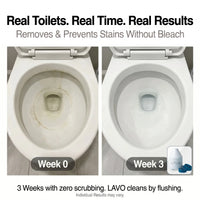
That's the entire idea behind LAVO. One tab lasts roughly 30 days (about 250 flushes), the pod itself is reusable, and most people with an existing ring see it fully dissolve within one to two weeks. After that, nothing new forms — because the chemistry is working before the deposit ever gets a chance to bond.
If you're in a particularly hard water region — Phoenix, Las Vegas, LA, parts of Texas, Florida, or the UK — this is where the difference between "no treatment" and "continuous treatment" stops being subtle and becomes obvious within days.
If you already have a bad ring
Acid needs contact time on old, established buildup — there's no getting around that if a ring has been sitting for months or years.
The realistic approach: an acid solution (citric acid or vinegar) left in the bowl for 30–60 minutes, then light scrubbing while it's still active. That handles what's there today.
What handles tomorrow is a system that keeps working after you walk away — which is the actual gap a one-time clean can't close.
Frequently asked questions
What's the best toilet cleaner for hard water specifically?
Anything with citric, lactic, or phosphoric acid. For daily prevention without lifting a brush, a citric acid tank pod is the simplest system, since it's working with every flush instead of once a week.
Does CLR work on toilet limescale?
Yes — it uses lactic and gluconic acid and works well as an initial deep clean. It's just not built for the tank, so you'd be repeating it manually every few weeks forever. A tank pod removes that treadmill entirely.
How do I know if I actually have hard water?
Scale around faucets, a showerhead that clogs, spotty glassware from the dishwasher, and a toilet ring that returns within days are the classic signs. Test strips confirm it in under a minute.
Does WD-40 remove hard water stains?
It's a folk remedy that can make deposits slicker so they wipe off more easily, but it doesn't dissolve limescale, and it can leave a film that affects your flush. Not a real fix.
I have a water softener — do I still need this?
If it's working and maintained, probably not much. A tank pod is the far cheaper option for households where the toilet is the only real trouble spot.
The bottom line
Stronger bleach was never going to fix this. It was never the right tool.
If the ring keeps coming back no matter how hard you scrub, the fix isn't more effort — it's acid, delivered continuously, so the deposit never gets a chance to bond in the first place.