
Quick Answer: The best automatic toilet cleaner for 2026 is one that uses citric acid delivered through a controlled-release in-tank pod. This is the only format that (1) treats the source of the problem — the incoming water chemistry — rather than the symptoms, (2) continuously prevents mineral deposits with every flush, and (3) doesn't damage rubber tank components or off-gas chlorine. Bleach-based automatics remain the most widely sold, but for the actual problem most households face — the limescale ring — they don't work.
The Automatic Toilet Cleaner Categories in 2026
The market has a few distinct product types, and they are not equivalent:
In-tank bleach tablets and pods: Still the market majority. Products like Clorox 2000 Flushes, Kaboom, and similar. Active ingredient: sodium hypochlorite (bleach). Effective at disinfection and masking organic staining. Ineffective at dissolving limescale. Corrodes rubber tank components over time. This is the category most people use and the one with the most documented problems.
In-tank citric acid pods: The newer category. Active ingredient: citric acid. Dissolves calcium carbonate through a chemical reaction. Safe for rubber components and septic systems. Non-toxic for pets and children. This is the chemistry that actually addresses the ring.
In-bowl rim dispensers: Gel dispensers hanging under the rim. Apply chemistry to the bowl surface only, not to the incoming tank water. Most are bleach-based. Reduce manual scrubbing frequency for some users but don't prevent the ring from forming at the tank-water level.
Why the Ring Test Is the Only Test That Matters
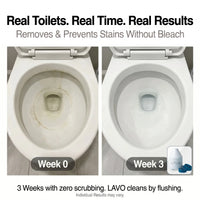
The simplest way to evaluate any automatic toilet cleaner: does the ring come back? If you're using an automatic cleaner and still have a visible ring within 3 to 7 days of scrubbing, the product is not addressing your problem. It may be disinfecting, it may be making the water smell fresh, but it isn't doing the job most people buying it are trying to accomplish.
Citric acid tank pods — including LAVO — consistently pass this test in hard water households where bleach products consistently fail. The difference isn't brand quality or product strength. It's the chemistry.
What to Look for on the Label
Active ingredient: sodium hypochlorite or chlorine = bleach product. Active ingredient: citric acid, lactic acid, or similar organic acid = limescale-dissolving product. If the product lists no active ingredients, that's worth noting.
Format: controlled-release pod housing = consistent chemistry over 30 days. Loose tablet = faster dissolution, less consistent release.
Septic safe: citric acid products are. Bleach products typically are not recommended for regular use in septic homes.
Pet safe: citric acid at toilet bowl concentrations is non-toxic. Bleach products require caution for households where pets drink from toilets.
Frequently Asked Questions
Is there an automatic toilet cleaner that works for very severe hard water?
Yes — a citric acid tank pod is specifically the right chemistry for hard water mineral deposits. Users in Phoenix, Las Vegas, and Los Angeles — some of the hardest water markets in the US — report the first ring-free toilet experiences of their lives after switching to a citric acid system.
How long does an automatic citric acid pod last compared to bleach tablets?
A LAVO citric acid tab lasts approximately 30 days or 250 flushes. Standard bleach tablets have similar lifespans. The difference is in what happens during those 30 days — continuous mineral dissolution vs. continuous bleach chemistry.
Can I use an automatic cleaner in a newly installed toilet without problems?
Yes. Starting with a citric acid system from installation means your new rubber components are never exposed to chlorine degradation. It's the best time to start.
Find the citric acid automatic cleaner that actually prevents the ring at lavopure.com — 30-day money-back guarantee, free tracked shipping.