
If your toilet ring keeps coming back, the best drop-in is usually not the bluest tablet or the strongest-smelling one.
It’s the one with the right chemistry.
Most toilet drop-ins are made to freshen the bowl, color the water, or bleach surface stains. That can make the toilet look cleaner for a while.
But if your real problem is limescale, most of those products are solving the wrong problem.
Quick answer
If you want a toilet drop-in that actually helps with limescale, look for an acid-based active ingredient such as:
-
Citric acid
-
Lactic acid
-
Another mild descaling acid
These ingredients help break down calcium-based mineral buildup over time.
Most standard blue or green chlorine tablets do not dissolve limescale.
They usually:
-
Bleach the staining on top
-
Make the water look “active”
-
Add fragrance
-
Leave the mineral deposit underneath
That is why the ring often comes back within a few days.
Why most toilet drop-ins fail on limescale
A lot of toilet tablets are designed for:
-
Disinfecting
-
Whitening
-
Fragrance
-
Blue or teal water
Those things are not useless.
They are just not the same as removing hard water scale.
If the ring in your toilet is caused by mineral buildup, a cleaner can make the bowl look better without actually removing the deposit itself.
That is where people get frustrated.
The common pattern
This is what usually happens:
-
You drop in a blue tablet.
-
The bowl looks better for a few days.
-
The ring fades a bit.
-
The same ring comes back.
-
You assume you need a stronger tablet.
Usually, you do not need a stronger version of the same thing.
You need different chemistry.
What limescale actually is
Limescale is a mineral deposit.
In toilets, it usually forms from hard water, especially at the waterline.
Over time, calcium and other minerals build up into a rough layer. Once that happens, new discoloration clings to it more easily.
That is why the toilet can keep looking dirty even after repeated cleaning.
Why that matters
Limescale is not like normal dirt.
Normal dirt can often be wiped away.
Limescale usually needs to be dissolved.
If you do not remove the mineral layer, the ring keeps returning.
Why bleach-based tablets don’t solve the ring
Many common toilet drop-ins are bleach-based.
They can help with:
-
Whitening
-
Odor
-
Bacteria
-
Temporary clean appearance
But they are usually weak when it comes to dissolving mineral deposits.
So if the real issue is calcium buildup, bleach often changes the look of the stain more than the structure of the deposit.
That is why the bowl can seem cleaner, but the ring still returns fast.
Blue water is not proof it works on limescale
This part matters more than people think.
Blue water feels reassuring. It gives the impression that the tablet is cleaning with every flush.
But in many products, the color is just dye.
That means:
-
Blue water tells you the product is releasing into the tank
-
It does not tell you it can dissolve hard water scale
-
It does not prove it is fixing the ring
A visible effect is not always a useful effect.
The chemistry that actually works on limescale
If you are shopping specifically for a limescale problem, acid-based cleaners are the category to look at.
That is because acids can react with calcium-based deposits and help break them down.
Citric acid
Citric acid is one of the best ingredients for ongoing toilet limescale control.
Why it works well:
-
It targets mineral buildup
-
It is well suited to repeated use
-
It helps with the actual deposit, not just the discoloration
-
It is a practical fit for hard water homes
For most households, this is the ingredient that makes the most sense.
Lactic acid
Lactic acid is another good option.
It is often found in gentler or eco-focused cleaning formulas and can also help break down calcium buildup.
If you are looking for a non-bleach option, lactic acid is a good sign on the label.
Phosphoric acid
Phosphoric acid can also dissolve mineral deposits.
It is effective, but it is more common in stronger descaling products than in easy everyday drop-ins.
For most people, citric acid is the simpler and more user-friendly option.
Best toilet drop-in formats compared
The ingredient matters most.
But the format matters too.
Some delivery systems work much better than others.
1. Loose dissolving tablets
These go straight into the tank and dissolve directly in the water.
They can work, but there are two common issues:
-
If they are bleach-based, they still do not solve limescale well
-
If they are acid-based, some dissolve too quickly to stay effective long enough
That makes them hit-or-miss for long-term results.
2. Controlled-release pod or housing system
This is usually the best format for limescale control.
Why:
-
It releases the active ingredient more steadily
-
It helps maintain a more consistent dose
-
It supports ongoing maintenance instead of one short burst
-
It fits the reality that limescale comes back gradually
If your goal is to stop the ring from rebuilding, this is usually the smartest format.
3. In-bowl rim cages
These can help with bowl freshness and surface appearance.
But they usually:
-
Focus on the bowl surface only
-
Do not treat tank water the same way
-
Often rely more on bleach and fragrance
If your main issue is hard water scale, they are usually not the best long-term answer.
How to read the label before you buy
This is the easiest way to avoid wasting money.
Before buying any toilet drop-in, check the active ingredient.
If it says chlorine or sodium hypochlorite
That usually means bleach.
Good for:
-
Whitening
-
Disinfecting
-
Freshening
Usually not best for:
-
Dissolving limescale
-
Breaking down mineral rings
-
Long-term hard water buildup control
If it says citric acid, lactic acid, or phosphoric acid
That means you are looking at chemistry that actually makes sense for limescale.
That does not guarantee the product is perfect.
But it does mean it is built for the right type of problem.
If the label is vague
That is usually a bad sign. If the product hides what is doing the cleaning, it becomes much harder to tell whether it is for:
-
Mineral removal
-
Surface whitening
-
Fragrance only
-
General bowl freshness
Clear labels are better.
What the best toilet drop-in for limescale should have
If you want the best chance of real results, look for these things:
-
An acid-based active ingredient, especially citric acid
-
Clear ingredient labeling
-
A controlled-release format
-
A product built for hard water or mineral buildup
-
A system designed for ongoing maintenance, not just short-term appearance
That is what separates a real limescale solution from a cosmetic one.
Why citric acid is usually the best choice
For most homes, citric acid is the best overall option.
It hits the sweet spot between:
-
Effective enough for mineral buildup
-
Gentle enough for regular use
-
Familiar enough that people understand what it does
-
Practical enough for ongoing toilet maintenance
Most people do not want another deep-cleaning ritual.
They want the ring gone and the toilet easier to maintain.
That is exactly why citric-acid-based systems make sense.
What to expect if you already have a ring
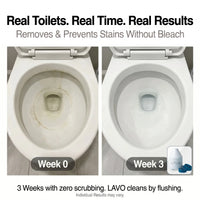
If your toilet already has visible limescale, a citric-acid-based drop-in can still help.
Typical pattern:
-
Light to moderate buildup may start softening within a few days
-
Moderate rings often show visible improvement within 3 to 7 days
-
Older, heavier buildup may take 2 to 3 weeks
That is normal.
A controlled-release product is meant to work steadily, not all at once.
The upside is that once the ring is reduced, the same system can help slow down how quickly it comes back.
Frequently asked questions
How long does a citric acid toilet drop-in take to work?
For moderate limescale, many people notice visible improvement within 3 to 7 days.
Heavier buildup can take two to three weeks.
Can I use a citric acid drop-in in a low-flow or dual-flush toilet?
Yes.
The treatment is released into the tank water, so each flush still carries some of it into the bowl.
Are there toilet drop-ins that help with both limescale and bowl freshness?
Yes.
Some formulas combine acid-based cleaning with other ingredients for freshness or general residue control.
If limescale is your main concern, the acid is still the most important part.
Is the most expensive toilet drop-in always the best one?
No.
The formula matters more than the price.
A cheaper acid-based product can be far more useful for limescale than a premium bleach tablet that only hides the problem.
Where LAVO fits
LAVO was built around one simple idea:
A recurring toilet ring is usually a chemistry problem before it is a scrubbing problem.
That is why LAVO uses a controlled-release pod with citric acid instead of the standard bleach-tablet approach.
What that means in practice:
-
It is built for mineral buildup, not just whitening
-
It helps support ongoing bowl maintenance
-
It is designed for people tired of scrubbing the same ring every week
-
The reusable pod housing means you replace the tab, not the whole plastic system
If you are comparing toilet drop-ins for hard water and limescale, this is the real question to ask:
Does the product actually help dissolve mineral buildup, or does it only bleach the stain on top of it?
Final takeaway
If your toilet ring keeps coming back, stop choosing drop-ins based on color, scent, or branding.
Choose based on chemistry.
The best toilet drop-in for limescale usually has:
-
Acid-based cleaning
-
Clear labeling
-
Consistent release
-
Real hard water relevance
That is why citric-acid-based systems make more sense than standard blue bleach tablets for mineral rings.