
Quick Answer: The most effective way to remove a toilet ring without scrubbing is to treat the source — the water — rather than the surface. A citric acid tablet placed inside your toilet tank dissolves mineral deposits chemically with every flush, eliminating the ring permanently without any physical scrubbing required.
You've scrubbed it on Monday. By Thursday it's back.
You've tried the gel. The bleach. The pumice stone. The "miracle" spray that smelled like it could strip paint. And still — that brown, rust-colored ring sits there like it owns the place.
Here's what nobody tells you: the ring was never a cleaning problem. It was always a chemistry problem. And that's why scrubbing it off never actually worked.
Why Your Toilet Ring Keeps Coming Back (This Is the Part Nobody Explains)
Toilet rings are made of calcium carbonate — the same mineral that builds up in your kettle and on your shower head. Every single time your toilet flushes, the water deposits a microscopic layer of this mineral onto the porcelain at the waterline.
You can't see it happening. But after 48-72 hours of continuous flushing, those microscopic layers stack up into the visible brown ring you're staring at right now.
When you scrub the ring off, you remove what's visible. But the very next flush starts depositing calcium again. The cycle begins immediately. You haven't solved anything — you've just reset the clock.
Bleach makes this worse, not better. Bleach oxidizes the pigment of the stain temporarily, making it look lighter. But it doesn't react with calcium carbonate at all. The mineral deposit is still physically there — just temporarily less yellow. Within days, new mineral layers stack on top and the ring returns, often darker than before.
This is why people who use bleach tablets in their tank still scrub their toilets every week. The bleach is masking, not dissolving.
What Actually Dissolves Calcium (The Chemistry That Changes Everything)
Calcium carbonate is alkaline. The only thing that dissolves an alkaline compound is an acid.
Specifically: citric acid.
This is the same compound found naturally in lemons, limes, and oranges. It's what's in every professional descaler, every kettle cleaning tablet, every limescale remover on the market. When citric acid contacts calcium carbonate, it triggers a chemical reaction that converts the solid mineral deposit into calcium citrate — which is water soluble and simply flushes away.
No scrubbing. No elbow grease. The chemistry does the work.
This is why that old "pour lemon juice into your toilet" trick actually works — to a point. The problem is consistency. A single lemon juice treatment removes what's there today. By tomorrow, the water is already depositing calcium again.
The solution isn't to clean the ring. It's to prevent the ring from forming at all.
The Method That Removes the Ring and Keeps It Gone
If citric acid dissolves the ring, and the ring forms from the water, then the answer is obvious: put citric acid in the water permanently.
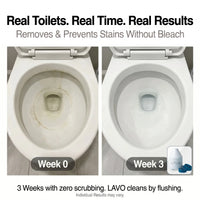
This is exactly what LAVO does. It's a small pod that sits inside your toilet tank. Inside the pod is a concentrated citric acid tab. With every single flush, a precise amount of citric acid is released into the tank water — which then flows through the bowl, continuously dissolving any mineral deposits before they can accumulate.
The first sign it's working: the water turns vivid blue within the first few flushes. Not from dye — from the formula doing exactly what it's designed to do.
By 48-72 hours: the existing ring starts dissolving without any scrubbing.
By week 2: it's gone entirely.
After that: it doesn't come back. Because the citric acid is treating every flush, limescale never gets the chance to build up. There's nothing to scrub because there's nothing to remove.
One tab lasts approximately 30 days (around 250 flushes). Then you replace the tab — the pod housing is reusable forever.
What About the DIY Methods?
There are a few popular alternatives worth addressing honestly:
Baking soda and vinegar: Creates a satisfying fizz that feels like it's doing something dramatic. What's actually happening is an acid-base neutralization reaction that produces CO2 gas (the bubbles) and water. The cleaning effect is minimal and the acetic acid in vinegar is too weak to effectively dissolve significant calcium buildup. Useful for light surface stains. Does nothing for a real mineral ring.
Pumice stone: Actually works for physical removal. The problem is it's abrasive — over time it scratches porcelain, creating microscopic grooves where bacteria and minerals accumulate faster. You're trading short-term results for long-term damage.
Coca-Cola: The phosphoric acid in Coke does have mild descaling properties. It also leaves a sticky sugar residue in your bowl. And you need to leave it sitting for hours. An interesting party trick, not a practical solution.
Bleach tablets: The most common choice, with the worst long-term consequences. Beyond the ineffectiveness on calcium discussed above, chlorine bleach slowly degrades the rubber seals and gaskets inside your tank. Over 12-18 months, this causes leaks, running water, and expensive plumber visits. The manufacturer warnings on most bleach tablets literally state this. Plumbers know it. Most homeowners don't.
Hard Water Areas: Why the Ring Returns Faster for You
If you live in the US Southeast, California, Texas, Arizona, most of London and Southeast England, or large parts of Australia — your water contains significantly elevated levels of dissolved calcium and magnesium. This is hard water.
In hard water areas, the calcium deposition rate is 3-4 times higher than in soft water areas. That's why some people see their ring return in 2 days while others go a full week before it reappears. It's not about how clean you are — it's about what's in your water.
For hard water households, continuous citric acid treatment isn't optional. It's the only thing that keeps up with the constant mineral input. Periodic cleaning with any method simply can't match the rate of deposition.
Frequently Asked Questions
Will this work if my ring is very dark or has been there for years?
Yes, but allow more time. Heavily established rings with years of layered mineral buildup may take 2-3 weeks of continuous citric acid treatment to fully dissolve. Don't scrub during this period — let the chemistry work. The results will be more complete than any scrubbing could achieve.
Is citric acid safe for my septic system?
Completely safe. Citric acid is fully biodegradable and breaks down naturally in water. Unlike bleach, which kills the beneficial bacteria your septic tank depends on, citric acid is neutral to septic biology.
What if my toilet has a colored bowl or non-standard tank?
Citric acid is pH-safe for porcelain, vitreous china, plastic, rubber, chrome, and stainless steel. It works with 99% of toilet tank designs worldwide including standard, dual-flush, low-flow, and pressure-assisted systems.
Can I use citric acid powder directly in the tank?
You can, but it requires measuring, mixing, and remembering to re-add it regularly. The pod system exists specifically because consistency is the entire point — you need continuous treatment across every flush, not an occasional manual dose.
How quickly will I see results?
Most people notice vivid blue water within the first 2-3 flushes. Visible ring reduction typically appears within 48-72 hours. Complete elimination of an existing ring usually takes 7-14 days depending on the severity of buildup.
The toilet ring is one of the most persistent problems in home cleaning — not because it's hard to solve, but because everyone keeps solving the wrong problem. Stop scrubbing the symptom. Treat the cause.
The water is the problem. The water is also where the solution goes.
Ready to stop scrubbing permanently? LAVO is available at lavopure.com with free tracked shipping to the USA, UK, Australia, and Canada. Use code WELCOME10 for 10% off your first order.