
Quick Answer: If your toilet bowl gets a ring within 2 to 3 days of scrubbing — or even faster — you almost certainly live in a very hard water area. The speed of ring formation is directly proportional to the calcium and magnesium concentration in your water supply. With high mineral content, every flush deposits more calcium per fill cycle. No amount of scrubbing or bleach stops a ring that reforms this quickly because neither addresses the incoming mineral load.
The Exact Mechanism Behind Fast Ring Formation
Tap water contains dissolved calcium carbonate. When this water enters your toilet bowl or tank, the change in pressure and temperature during flushing causes some calcium to crystallize out of solution and adhere to the porcelain at the waterline. This is called mineral precipitation.
In soft water areas (under 60 mg/L calcium carbonate), this process is slow. A visible ring might take several weeks to form. In very hard water areas (over 200 mg/L — which includes most of Southern California, the US Southwest, and much of Southeast England), the deposition rate is dramatically higher. Multiple grams of calcium deposit per thousand liters of water flushed. In practical terms, at 12 flushes per day in water this hard, a visible ring can appear within 48 to 72 hours.
You are not cleaning badly. You are fighting a chemistry problem with a mechanical solution (scrubbing), and chemistry always wins.
Why Bleach Makes This Worse, Not Better
When you apply bleach to a fast-forming ring, it oxidizes and removes the organic coloring layer on top of the mineral deposit. The ring looks gone. Within hours, new calcium deposits on the existing (now invisible) mineral base, and new organic material from the water settles on top. The ring is visually back within days.
Each bleach application temporarily clears the surface while leaving the mineral foundation intact. Over months, that mineral foundation grows thicker even as you scrub it weekly. The ring comes back faster and faster because the substrate for new deposits grows larger.
The Only Fix That Keeps Up with Fast Ring Formation
If the ring forms in 2 to 3 days, you need a cleaning system that works 12 to 15 times a day — once with every flush. Manual cleaning can't achieve this. Periodic strong cleaners can't achieve this. The only system that matches the deposition rate of very hard water is continuous chemical treatment in the tank water itself.
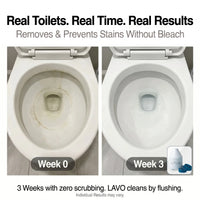
A citric acid pod in your tank releases a controlled amount of citric acid with every flush. The calcium ions from the incoming water are neutralized before they can precipitate onto the porcelain. The ring doesn't come back because the chemistry preventing it is happening every time the toilet is used.
Users in Las Vegas, Phoenix, and Southeast London — some of the hardest water areas in the world — report going from a ring every 2 to 3 days to no ring at all after switching to a citric acid tank system. Same hard water. Same toilet. Different chemistry.
How to Check Your Water Hardness
Your local water utility is legally required to publish an annual water quality report. Search online for your utility name plus 'water quality report' — the hardness measurement will be listed in mg/L or grains per gallon. Over 180 mg/L means very hard water. Over 250 mg/L means expect the fastest ring formation.
Physical signs of very hard water: white scale crust around all faucets, showerheads that spray unevenly from mineral blockage, cloudy glassware from the dishwasher, and — most obviously — a toilet ring that's back within days no matter what you do.
Frequently Asked Questions
Why does my neighbor's toilet not have this problem if we're on the same water supply?
Several factors influence individual ring formation speed: flush frequency (more flushes = more deposits per day), toilet age (older porcelain is often more porous and deposits adhere faster), and existing mineral buildup that acts as a base for new deposits.
I just moved and suddenly have a terrible ring problem. What changed?
Your new home is almost certainly in a higher water hardness area. Water hardness varies significantly by region and even by neighborhood depending on the source. The ring formation rate you're experiencing reflects your local water chemistry, not your cleaning habits.
Can I test my water hardness at home?
Yes. Inexpensive water hardness test strips are available online and at hardware stores. They give you a reasonably accurate reading in about 30 seconds. Compare your result to the hardness scale: over 180 mg/L means continuous treatment is the only approach that will keep up with your deposition rate.
The ring that comes back in 2 days needs a solution that works every flush. See how right here!