
Gripping a scrub brush hard enough to break through crusted mineral buildup is a rough ask for any hand. If you're dealing with arthritis, that grip pressure translates straight into joint pain that can linger for hours afterward. Add in the twisting motion of reaching under the rim, the sustained forward bend that flares up a bad back, and you've got a chore that's actively working against your body every single time you do it.
Here's the thing worth sitting with: scrubbing was never actually the fix. It's the default response to a chemistry problem nobody explained properly. Once you understand what's really happening on that porcelain, you'll see why scrubbing is a workaround for a problem that has a much easier answer — one that doesn't require your hands, back, or knees to do the heavy lifting at all.
The Physical Toll Nobody Talks About
Scrubbing a toilet bowl isn't a light task, even for someone without joint issues. It requires a sustained pincer grip on the brush handle, repetitive wrist rotation, and forward flexion at the hips and lower back, often held for several minutes at a stretch. For anyone with arthritis in the hands or wrists, that repetitive gripping motion is one of the specific movements known to aggravate joint inflammation. For anyone managing chronic lower back pain, the sustained forward bend over the bowl edge is exactly the posture physical therapists usually tell people to avoid.
None of this is a reflection of doing the chore "wrong." The motion itself is simply demanding on joints and soft tissue that don't have the cushioning or flexibility they used to. The problem isn't your technique. It's that the entire cleaning method assumes a level of physical ease that a scrubbing task is going to work against on principle.
Why the Buildup Requires So Much Force in the First Place
To understand why this doesn't have to be your only option, it helps to know why the ring needs that much scrubbing pressure to begin with.
Every time your toilet refills, standing water sits in the bowl and tank until the next flush. Along the exposed porcelain at the waterline, that water slowly evaporates between uses. Water evaporates; the minerals dissolved in it don't. Calcium carbonate and magnesium get left behind, and with each evaporation cycle, more concentrates in the same narrow band. Given a few weeks, those minerals crystallize into rough, jagged deposits that physically bond into the microscopic pores of the porcelain glaze.
That's why it takes real pressure to remove — you're not wiping something off a surface, you're trying to break a mineral bond that's fused into the texture of the porcelain itself. The harder that bond, the more force your hands and back need to supply to break it loose. If you've noticed the ring gets worse the longer it sits between cleanings, this piece on the recurring ring timeline explains exactly how fast that mineral bond forms.
Why Bleach Doesn't Reduce the Scrubbing Either
A common assumption is that a stronger cleaner means less scrubbing. With bleach specifically, that's not how the chemistry works. Bleach is an oxidizer — it breaks down organic pigment through a chemical reaction, which is why it's effective against mold stains and bacteria. But calcium and magnesium aren't organic pigment. Bleach has no mechanism for dissolving a mineral crystal structure, so the actual hardness of the buildup — the part demanding physical force to remove — stays completely untouched no matter how long you let bleach sit.
That means someone dealing with joint pain can use the strongest bleach product on the shelf and still need the same aggressive scrubbing motion to break the mineral bond. The chemical strength of the cleaner and the physical effort required to remove mineral scale are simply two different things. If you've been relying on bleach tablets specifically, this breakdown of bleach and tank hardware covers what else it's doing to your tank's rubber components over time.
The Chemistry That Removes the Need for Force
Here's the actual fix, and it has nothing to do with a better brush or more determination. Mineral scale responds to acid, not to scrubbing pressure. Citric acid — a mild, organic weak acid, the kind naturally found in citrus fruit — chelates calcium and magnesium ions, meaning the acid molecules bind directly to those mineral ions and convert them into water-soluble citrates. Once that conversion happens chemically, the mineral bond holding the crust to your porcelain is already broken before you ever touch a brush.
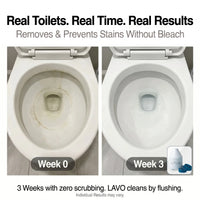
Applied directly to an existing ring, this means what used to require hard scrubbing becomes a light wipe. The acid has already done the difficult work of dissolving the mineral bond; your hands just need to clear away what's left. This guide on removing a toilet ring without scrubbing walks through the exact application method, including how long to let it sit before a light pass with a brush is enough.
Making the Fix Permanent Instead of Repetitive
A single acid treatment solves an existing ring, but it doesn't stop new evaporation from restarting the mineral concentration process the next day. Without something addressing the water on an ongoing basis, the ring returns within days, and you're back to needing physical effort to remove it again.
This is why treating the water continuously with a citric acid tank pod breaks the cycle before minerals have a chance to bond to porcelain. A pod sitting in the tank releases a small, steady dose of citric acid into the water with every refill, keeping calcium and magnesium chelated and dissolved before they ever get the uninterrupted time they need to crystallize onto the porcelain. No hardened mineral bond means no situation that demands hard scrubbing pressure to begin with.
Adjusting the Rest of Your Routine
Beyond the water chemistry itself, a few practical adjustments make what cleaning remains easier on your joints:
- Use a long-handled angled brush so your wrist stays in a neutral position instead of twisting to reach under the rim, and your back doesn't need to bend as far forward.
- Clean from a seated position when possible. A stable stool positioned beside the toilet lets you reach the bowl and rim without kneeling or standing bent over.
- Switch to disposable wand heads for daily wipe-downs, which need only light pressure and eliminate any wringing or gripping motion.
- Break cleaning into shorter sessions rather than one longer scrub, giving joints recovery time between motions instead of sustained repetitive strain.
None of these require pushing through discomfort or accepting that bathroom cleaning has to hurt. They're adjustments to a task that's mostly become optional once the mineral chemistry underneath it is handled differently.
Rethinking What "Clean" Requires
Scrubbing a toilet bowl with real force isn't a sign of thoroughness. It's a sign that mineral scale has been allowed to harden into something that requires force to remove. Once the water itself is treated so that hardening never happens, the physical demand mostly disappears along with it. For anyone whose hands, back, or knees have been paying the price for a chore that was never actually designed around them, that's a real difference — not a smaller version of the same task, but a genuinely different one.