
Nobody wakes up on a Sunday hoping to spend twenty minutes scrubbing behind the toilet seat. You have better things to do with your life. But most mornings aren't Sunday — they're a sprint between the alarm and the door, coffee in one hand, keys in the other, and a bathroom you don't have five seconds to think about, let alone clean.
The trick isn't finding more time. It's attaching bathroom maintenance to motions you're already making, so the upkeep happens without ever becoming its own task. Here are three ways to do that across both a busy master bath and a guest bathroom that barely gets touched during the week — none of which add a single extra minute to your morning.
Way One: Attach It to Something You're Already Doing
The fastest way to skip a chore forever is to never treat it as a separate chore. Instead of "clean the toilet" living on a mental to-do list competing with everything else, tie it to an action that's already automatic.
Here's how that looks in practice. While you're brushing your teeth — two minutes you're standing in that bathroom regardless — a damp cloth wipe of the sink and faucet takes maybe fifteen seconds, and you're already standing right there with wet hands. While the shower's heating up, a quick swipe of the toilet seat and lid with a wipe you keep in a drawer costs about ten seconds. Neither adds time to your morning. They're layered on top of minutes you were spending in that room anyway.
This works because it removes the decision-making entirely. You're not choosing to clean; you're just doing a thirty-second motion while your body's already in that space for something else. Decision fatigue is what turns small tasks into avoided tasks — remove the decision, and the task mostly takes care of itself.
Way Two: Separate "Maintenance" from "Deep Clean" Permanently
A lot of morning-time frustration comes from treating every bathroom task as equally demanding. It's not. There's a real difference between wiping a counter and scrubbing a mineral ring, and mixing those two categories together is what makes bathroom care feel endless.
Here's the mechanism behind why the harder job — the waterline ring — keeps needing your attention in the first place. Standing water in the toilet tank and bowl sits at room temperature between flushes, and along the exposed porcelain at the waterline, that water slowly evaporates. Evaporation concentrates dissolved calcium carbonate and magnesium left behind in the water, and over weeks those minerals crystallize into rough deposits that physically bond into the microscopic pores of the porcelain. That's the scrubbing-level job. It's a completely different task from wiping a counter, and it deserves a completely different solution — not five more minutes squeezed into a Tuesday morning.
If you've been lumping the ring in with your daily wipe-downs and wondering why it never seems to actually go away, this piece on why the ring returns within days explains the timeline you're up against.
Way Three: Handle the Hard Job Passively, Once, Instead of Repeatedly
This is the way that actually removes the biggest time sink from your week rather than just shrinking it. If mineral scale forms because standing water evaporates and concentrates calcium and magnesium over time, the fix isn't scrubbing harder later — it's keeping those minerals from hardening in the first place.
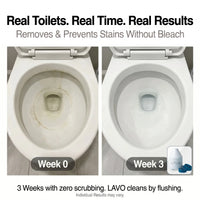
Citric acid is a mild organic acid that chelates calcium and magnesium ions, meaning the acid molecules bind directly to those minerals and convert them into water-soluble citrates that flush away instead of drying into crust on the porcelain. A continuous citric acid tank pod sitting in the tank releases a small, steady dose of that acid into the water with every refill, so minerals stay dissolved instead of getting the uninterrupted time they need to crystallize.
This is why treating the water continuously with a citric acid tank pod breaks the cycle before minerals have a chance to bond to porcelain. You set it up once — takes about thirty seconds — and it works in the background for weeks, which means the scrubbing session that used to eat into your one free morning stops needing to happen at all. That's the real time savings: not doing the hard job faster, but not doing it at all.
A lot of people reach for bleach tablets thinking they're accomplishing the same thing. They're not. Bleach is an oxidizer — it bleaches organic pigment white through a chemical reaction, which is useful for stains and bacteria, but it does nothing to dissolve calcium or magnesium. The mineral crust stays exactly as hard underneath a bleach tablet as it would without one. If you've been relying on tank tablets and still fighting the same ring every week, this breakdown of bleach and tank chemistry explains why that approach hasn't been working.
Applying All Three to Both Bathrooms
Your master bath and your guest bathroom need slightly different treatment, since one gets used constantly and the other barely gets touched during the week.
For the master bath, where you're in and out daily anyway, the attached fifteen-second wipes from Way One do most of the heavy lifting. You're already there multiple times a day, so the counter and faucet rarely have time to build up visible grime between passes.
The guest bathroom is trickier, because there's no natural moment to attach maintenance to — nobody's brushing their teeth in there every morning. This is exactly where the passive tank treatment from Way Three earns its keep. A room that sits unused for days at a stretch gives standing water far more uninterrupted time to evaporate and concentrate minerals than a bathroom used ten times a day, so the ring tends to form faster in the room you're least likely to check. Setting up passive treatment there means you're not relying on remembering to clean a room you rarely enter.
What This Actually Saves You
None of these three ways require carving new time out of an already tight morning. Way One repurposes seconds you're already spending in the bathroom. Way Two stops you from mentally lumping a fifteen-second task in with a fifteen-minute one. Way Three removes the fifteen-minute task from your week entirely by addressing the mineral chemistry before it ever becomes a scrubbing job.
Add it up over a few months, and you're not managing a bathroom routine anymore — you've just made the bathroom mostly maintain itself while you get on with an actual morning. If your household runs on hard water and wants to understand exactly what's working against you at the tap, this guide to hard water and toilet buildup is worth reading before you set anything up.