
You scrubbed it until your arms ached on Saturday. By Tuesday, that same chalky brown line is creeping back across the porcelain, sitting right at the waterline like it never left. You used bleach. A lot of it. And somehow the toilet still looks the way it did before you started.
Here's the thing nobody tells you at the store: bleach was never built to remove that stain. It's not a scrubbing failure on your part. It's a chemistry mismatch. You've been using the wrong tool for the job, and once you understand why, the whole "why does this keep happening" mystery stops being a mystery.
What's Actually Sitting on Your Porcelain
That brownish-orange or gray crust isn't dirt in the way most stains are dirt. It's mineral scale — mostly calcium carbonate, with magnesium mixed in, plus whatever iron happens to be in your local water supply giving it that rust-like tint.
Here's how it gets there. Every time your toilet refills, water sits in the bowl and tank until the next flush. Along the exposed porcelain right at the waterline, that standing water slowly evaporates between uses. Water evaporates. Minerals don't. They get left behind, and with every evaporation cycle, more concentrate on the same narrow band of porcelain.
Given enough time — usually a few weeks for hard water areas — those concentrated minerals crystallize into rough, jagged deposits that bond directly into the microscopic pores of the porcelain glaze. This isn't a coating sitting on top of a smooth surface. It's mineral scale that's physically fused into texture that used to be smooth. That's why it feels gritty under a fingernail instead of just looking discolored.
If your water runs particularly hard, this process moves faster and the crust builds thicker than in areas with softer water. This breakdown of hard water and toilet buildup gets into exactly what's dissolved in your tap water and why some homes deal with this constantly while others barely notice it.
What Bleach Actually Does (And Doesn't Do)
Bleach has one job, chemically speaking: it's an oxidizer. Sodium hypochlorite reacts with organic pigment — the stuff that gives stains, mold, and algae their color — and breaks those pigment molecules apart through oxidation. The color disappears because the pigment structure itself gets destroyed. That's a real chemical reaction, and it's genuinely useful for surface bacteria and organic staining.
Here's the catch: calcium carbonate and magnesium aren't organic pigment. They're inorganic mineral compounds. Bleach has no chemical mechanism for breaking down a mineral crystal structure — there's no pigment to oxidize, no bond for hypochlorite to attack. You could soak that ring in bleach overnight and the mineral bond holding it to the porcelain wouldn't weaken even slightly.
So what actually happens when you bleach a hard water stain? In a lot of cases, you get a temporary lightening effect from any organic grime or light staining mixed into the mineral crust getting bleached white. It looks like progress. But the mineral structure underneath is untouched, and it's usually rough enough that it grabs new organic grime within 24 to 48 hours, restoring the visible color right on schedule. You didn't remove the stain. You bleached the surface of a problem that was never bleach-solvable to begin with.
There's a second cost too. Bleach sitting in a toilet tank over time degrades rubber components — the flapper valve, gaskets, seals — since hypochlorite is corrosive to rubber compounds with repeated exposure. If you've been dropping bleach tablets into your tank for "maintenance," this piece on bleach and tank hardware is worth a look before you replace another flapper valve.
The Chemistry That Actually Works: Acid, Not Oxidizer
Mineral scale needs a different kind of chemical reaction entirely. Calcium carbonate and magnesium deposits respond to acids, not oxidizers, because acids dissolve mineral bonds directly rather than bleaching pigment.
Citric acid — a mild, organic triprotic weak acid, the same compound found naturally in citrus fruit — works through a process called chelation. In plain terms, chelation means the acid molecule wraps around a calcium or magnesium ion and binds to it directly, converting the hardened mineral into a soluble citrate compound. Once that conversion happens, the mineral is no longer a solid crystal clinging to your porcelain. It's dissolved in the water, and it rinses away with the next flush.
This is also why citric acid tends to soften scale you can feel with almost no scrubbing pressure, while bleach leaves the same crust exactly as tough as it started. You're not fighting the mineral bond with elbow grease. You're dissolving it chemically first, so removal barely takes effort. This guide on removing toilet rings without scrubbing walks through the exact application method if you want to tackle an existing ring today.
Why the Ring Comes Back Even After a Good Acid Clean
Here's where a lot of people get frustrated even after switching products. A one-time acid treatment dissolves existing scale, but it doesn't stop new evaporation from starting the mineral concentration process again the next day. Fresh water refills the tank, sits, evaporates a little between flushes, and the whole cycle restarts from zero.
Think of it this way: cleaning once, no matter how effective the product, only resets the clock. It doesn't change the fact that your water is hard and evaporation is constant. If nothing addresses the water itself, the ring is mathematically going to come back — usually within three to seven days depending on how hard your local water runs.
Treating the Water Instead of Chasing the Stain
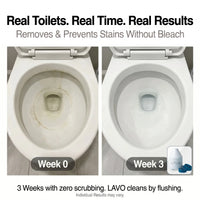
This is why treating the water continuously with a citric acid tank pod breaks the cycle before minerals have a chance to bond to porcelain. Rather than waiting for scale to harden and then dissolving it after the fact, a pod sitting in the tank releases a small, steady dose of citric acid into the water with every refill. Calcium and magnesium ions stay chelated and dissolved in solution from the start, instead of getting the chance to concentrate and crystallize along the waterline in the first place.
No hardened crystal structure means no rough, pitted surface for new grime or bacteria to grip onto either — which is part of why a passively treated toilet tends to smell cleaner between cleanings, not just look cleaner. The mineral problem and a lot of the odor problem share the same root cause, and treating the water addresses both at once instead of chasing each separately.
What This Means for Your Actual Routine
None of this means you'll never touch a toilet brush again. It means the crust you're currently fighting with real muscle every weekend stops forming at the rate it used to, so the maintenance that's left is light — a quick wipe instead of a scrub session that leaves your arms sore.
If you've been stuck in the same loop — bleach on Saturday, stain back by Tuesday, wondering if you're doing something wrong — you're not. You were just applying an oxidizer to a mineral problem, and no amount of scrubbing pressure changes that basic chemistry. Switch the approach to match the actual compound you're dealing with, and the frustrating three-day return cycle stops being inevitable.