
Every year, millions of Americans drop a blue tablet into their toilet tank and call it clean. Convenient, hands-off, effortless — the promise is right on the box. But plumbers across the country are quietly dealing with the aftermath: corroded flappers, failing gaskets, cracked seals, and toilets that run nonstop weeks after a bleach tablet was installed.
The hard truth? Bleach tablets are bad for your toilet tank. Not just a little — bad enough that many toilet manufacturers explicitly state that damage caused by in-tank tablets is not covered under warranty.
This article explains exactly what bleach tablets do inside your tank, why they don't actually solve the toilet ring problem, and what actually works — chemically speaking — to keep a toilet clean long-term without destroying it in the process.
What Bleach Tablets Actually Do Inside Your Toilet Tank
Bleach tablets work by dissolving slowly in the tank water, releasing chlorine with each flush. That sounds simple enough. The problem is that chlorine is not selective about what it attacks.
Inside your toilet tank, there are several rubber and plastic components that control how water moves from the tank to the bowl: the flapper (a rubber seal that opens and closes to release water), the fill valve, gaskets, and various washers and bolts. These parts are engineered to last 10–15 years with normal use. When bleach is continuously present in the water, that timeline shortens dramatically.
The rubber flapper is the most vulnerable component. Chlorine degrades rubber at the molecular level — causing it to become brittle, crack, and lose its ability to seal properly.
When the flapper fails to seal, water trickles continuously from the tank into the bowl. This is called a 'running toilet,' and it's one of the most common plumbing calls homeowners don't connect back to their cleaning routine. According to data from the American Society of Plumbing Engineers, 35% of plumbers report an increase in toilet tank corrosion in homes that use bleach tablets, and nearly 29% of toilet repair calls involve flapper damage linked to chemical cleaners.
Metal components aren't spared either. The bolts and washers securing the tank to the bowl can rust prematurely in a chlorine-rich environment, leading to leaks at the base of the tank — sometimes months before any visual warning sign appears.
Most troubling: many toilet manufacturers now include explicit warnings that in-tank tablet damage is excluded from product warranties. Drop a bleach tablet in your tank, and you've voided the warranty on a fixture that might cost $400–$800 to replace.
The Second Problem: Bleach Doesn't Actually Solve the Toilet Ring
Even if the plumbing damage wasn't a concern, bleach tablets still fail at their core job. They do not remove the toilet ring. They temporarily bleach it lighter.
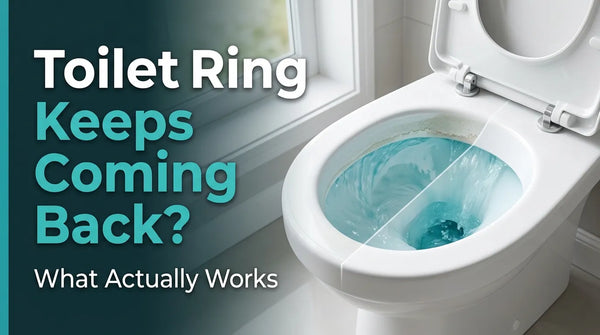
Here's why that matters. The brown, orange, or yellow ring that forms at the waterline of your toilet bowl is not dirt — it's limescale. Specifically, it's calcium carbonate and magnesium that have precipitated out of your water and bonded to the porcelain surface. If you live in a hard water area (which roughly 85% of American households do), your tap water is loaded with these dissolved minerals. Every flush deposits another microscopic layer on the bowl.
You scrub it off on Monday. By Thursday, a new layer has built up and the ring is back. Not because you didn't clean hard enough. Because you didn't address the water bringing the minerals in.
Bleach is an alkaline compound — it has a high pH. Limescale is also alkaline. Alkaline chemistry does not dissolve alkaline mineral deposits. Bleach bleaches the pigment of the stain, making it look lighter or invisible temporarily, while the calcium layer underneath remains completely intact. Within days, new mineral layers deposit on top, and the ring returns. This is the cycle — and bleach tablets accelerate it because you stop scrubbing, assuming the tablet is handling it, while the buildup actually continues unchecked beneath a bleached surface.
This is a fundamental chemistry mismatch. No amount of bleach will dissolve limescale, regardless of how concentrated or long-lasting the tablet is. It's the wrong tool for the job.
What Actually Removes and Prevents Limescale — The Chemistry That Works
To dissolve calcium carbonate, you need an acid. This is not complicated chemistry — it's the same reason you use CLR to clean your kettle, citric acid to descale your coffee machine, and vinegar to clean mineral buildup from faucets. Acids react with alkaline mineral compounds and break them down into water-soluble byproducts that flush away.
Specifically:
- Citric acid — found in lemons and limes; the active ingredient in most professional descaling products
- Acetic acid — white vinegar; effective for light buildup, short-lived
- Lactic acid — used in some eco-friendly cleaners
Of these, citric acid is the preferred option for continuous toilet cleaning because it's mild enough to be safe for plumbing components, effective against calcium carbonate at low concentrations, biodegradable, and non-toxic for pets and septic systems.
The challenge with vinegar — and with any one-time acid treatment — is that it's reactive. You apply it, it dissolves what's there, and then the next flush brings in fresh minerals from the tank. Without a continuous source of acid chemistry in the water, the cycle starts again immediately.
The solution to the toilet ring isn't a better cleaner. It's continuous preventive chemistry in the tank water — before minerals even reach the bowl.
How a Citric Acid Tank Pod Solves What Bleach Tablets Cannot
This is where the approach changes entirely. Instead of reacting to buildup after it forms, a citric acid tank pod prevents the buildup from forming in the first place.
A small reusable pod housing sits in the corner of your toilet tank — away from the fill valve and flush mechanism. Inside the pod is a citric acid tab. Every time you flush, a tiny controlled amount of citric acid dissolves into the flush water. That slightly acidic water is what contacts your bowl surface with each flush, and it changes everything: calcium carbonate cannot bond to porcelain in the presence of even a weak acid. The ring literally cannot form.
After the first few days of use, you'll notice the existing ring beginning to dissolve as the citric acid gradually breaks it down. Within one to two weeks, it's typically gone. From that point on, with continuous citric acid in the flush water, it doesn't come back.
One tab lasts approximately 30 days or 250 flushes. The pod housing is reusable indefinitely — you simply swap out the tab once a month, which takes about 30 seconds. That's the entire cleaning routine.
Compared to bleach tablets:
|
Approach |
Removes Ring? |
Prevents Ring? |
Safe for Plumbing? |
|
Manual scrubbing |
Yes — temporarily |
No |
Yes |
|
Bleach gel cleaner |
No — bleaches colour only |
No |
Moderate concern |
|
Bleach tank tablets |
No — masks stain only |
No |
NO — corrodes rubber |
|
LAVO citric acid pod ✓ |
Yes — dissolves deposit |
YES — every flush |
YES — plumbing-safe |
LAVO's citric acid pod operates on exactly this principle. It's designed to be safe for rubber seals, gaskets, septic systems, and pets — the precise opposite of what bleach tablets do over time. The marine-scented formula is non-toxic at the concentration levels present in the bowl water.
What LAVO Users Say After Switching from Bleach Tablets
|
Customer Experiences
|
FAQ: Bleach Tablets, Toilet Tank Safety & Citric Acid Cleaners
Are bleach tablets bad for your toilet tank?
Yes. Bleach tablets release chlorine continuously into the tank water, which degrades rubber components — particularly the flapper, gaskets, and seals — over months of exposure. Many toilet manufacturers explicitly exclude bleach-tablet damage from product warranties. They also fail to dissolve limescale, which is an alkaline mineral deposit that only acid chemistry can remove.
What happens if you put bleach in a toilet tank?
The chlorine in bleach attacks rubber and plastic components inside the tank, causing them to become brittle and fail prematurely. The most common result is a running toilet caused by a degraded flapper seal. This silent water leak can add significantly to your water bill over weeks before you notice it. Metal parts like tank bolts and washers also corrode faster in a chlorine-rich environment.
What is the best alternative to bleach toilet tank tablets?
A citric acid tank pod is the most effective alternative. Citric acid dissolves calcium carbonate (the mineral that causes toilet rings) — something bleach cannot do. It's safe for rubber components, septic systems, pets, and children. A pod sits in the tank and releases a small amount with every flush, preventing limescale buildup continuously rather than reacting to it after the fact.
Can bleach tablets void my toilet warranty?
Yes, in many cases. Major toilet manufacturers including American Standard, Kohler, and TOTO include warning language in their product documentation stating that damage caused by in-tank drop-in cleaners — including bleach tablets — is not covered under the product warranty. Check your toilet's documentation before using any in-tank tablet product.
How does citric acid clean a toilet?
Citric acid is a mild organic acid that reacts with calcium carbonate — the alkaline mineral compound that forms limescale. The acid breaks the mineral bond, dissolving deposits into water-soluble byproducts that flush away. Unlike bleach, which only bleaches the colour of the stain while leaving the mineral intact, citric acid removes the deposit entirely. Continuous low-level citric acid in flush water prevents new deposits from bonding to the porcelain.
Is citric acid toilet cleaner safe for septic systems?
Yes. Citric acid is fully biodegradable and breaks down into carbon dioxide and water. It does not disrupt the beneficial bacterial colonies that process waste in septic systems — unlike bleach, which can kill these organisms and cause septic system imbalances. LAVO's citric acid formula is specifically formulated to be septic-safe and has no negative effect on drainage systems or waterways.
The Bottom Line: The Wrong Chemistry Has a Cost
Bleach tablets are convenient, widely available, and heavily marketed. They are also, according to the evidence and to plumbing professionals who see the results, quietly damaging a fixture that costs hundreds of dollars to replace — while failing to solve the mineral buildup problem they're positioned to fix.
The toilet ring is a water chemistry problem. It requires acid chemistry to solve it. Continuous, preventive acid chemistry — the kind that changes the flush water rather than reacting to buildup after it's already there — is the only approach that actually breaks the cycle.
|
Try LAVO Risk-Free
|
If you're tired of fighting a problem that keeps coming back — and discovering that the product you trusted was quietly making your toilet worse — LAVO might be the last toilet cleaner you ever need to buy.