
Quick Answer: The most effective non-toxic toilet cleaner uses citric acid — a natural compound derived from citrus fruits — as its active ingredient. It's biodegradable, non-toxic to humans and pets, safe for septic systems, and more effective than bleach at dissolving limescale. The challenge is finding a product that delivers it continuously, which is where automatic tank systems have a significant advantage over periodic manual application.
Non-toxic cleaning has become a major consumer category — and with that growth has come an enormous amount of greenwashing. Products labeled "natural," "plant-based," "eco-friendly," and "non-toxic" can mean almost anything. Or nothing.
Understanding what actually makes a toilet cleaner safe — and what makes it effective — requires cutting through the marketing.
What "Non-Toxic" Should Actually Mean for a Toilet Cleaner
A genuinely non-toxic toilet cleaner should be:
Safe if inhaled in enclosed spaces: Bleach (sodium hypochlorite) releases chlorine gas when agitated by flushing. In a small bathroom, this is a daily low-level inhalation exposure. A truly non-toxic cleaner releases nothing volatile.
Safe for surfaces beyond the toilet: Bleach corrodes rubber, degrades certain metals over time, and can bleach porous surfaces accidentally. Non-toxic cleaners should be pH-safe for all common bathroom materials.
Safe for the water supply: What goes down your toilet enters the water system. Citric acid is fully biodegradable and breaks down into carbon dioxide and water. Chlorine compounds can form disinfection byproducts in water treatment systems.
Safe for pets who may drink from the bowl: At toilet bowl concentrations, citric acid is equivalent to very dilute lemon water. Non-toxic.
Safe for septic systems: Bleach kills the beneficial bacteria that break down waste in septic tanks. Citric acid is neutral to these organisms.
The Greenwashing Problem
Most products marketed as "natural" or "plant-based" fall into one of three categories:
Category 1: Renamed chemicals. "Naturally derived sodium lauryl sulfate" is still SLS. "Plant-based preservatives" can still be parabens. The word "natural" describes origin, not toxicity.
Category 2: Ineffective naturals. Some genuinely plant-derived products simply don't clean toilets effectively. Diluted essential oil solutions smell pleasant but don't dissolve limescale and don't disinfect at meaningful levels.
Category 3: Genuinely effective naturals. These exist but are fewer than the marketing suggests. The gold standard ingredient for toilet cleaning is citric acid — a natural compound that's both genuinely non-toxic and genuinely effective.
Why Citric Acid Is the Right Active Ingredient
Citric acid occurs naturally in lemons, limes, oranges, and other citrus fruits. It's used as a food preservative (the "citric acid" in most packaged foods is this exact compound). It's the active ingredient in every kettle descaler and professional limescale remover — not because it's "natural" in the marketing sense, but because it's the most effective acid for dissolving calcium carbonate at safe concentrations.
Its credentials for toilet cleaning:
• Dissolves limescale chemically (not just masking it like bleach)
• Biodegradable: breaks down into water and CO2
• Non-volatile: releases no fumes or gases
• pH-safe: won't corrode rubber, plastic, or metal tank components
• Septic safe: neutral to septic bacteria
• Pet safe: non-toxic at toilet bowl concentrations
• Child safe: not a chemical irritant at use concentrations
What About Vinegar?
White vinegar (acetic acid) is frequently recommended as a natural toilet cleaner and does have mild descaling properties. The practical limitations:
Vinegar's acidity (pH 2.4) is sufficient for light mineral buildup but insufficient for established hard water rings. It also requires manual application and dwell time — you can't use it in a set-and-forget tank system because acetic acid degrades rubber seals over time.
Citric acid has higher descaling power at equivalent concentrations, is safer for rubber components, and is stable in solution — making it suitable for continuous tank application.
The Delivery Method Problem
Even with the right ingredient, delivery matters. Pouring citric acid solution into your bowl once a week gives you one treatment — then the next 7 days of flushing deposits calcium unchecked. You're always catching up.
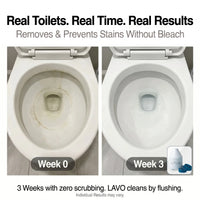
Continuous automatic delivery, where every flush water contains a small amount of citric acid, means the chemistry is working all the time. Calcium can't accumulate because it's being neutralized with every fill cycle.
FAQ
Q: Are non-toxic cleaners less effective than chemical ones?
For disinfecting bacteria: standard non-toxic cleaners are somewhat less powerful than bleach-based products. For limescale removal: citric acid is more effective than bleach because bleach has no mechanism to dissolve calcium. For continuous automatic cleaning: an automatic citric acid system has no equivalent in bleach-based products.
Q: What about "oxygen bleach" products marketed as natural?
Sodium percarbonate (oxygen bleach) is less harsh than chlorine bleach and does break down into water, oxygen, and soda ash. It's a valid intermediate option — better than chlorine bleach, less targeted than citric acid for limescale.
Q: Is baking soda effective?
Baking soda is alkaline, not acidic. It has mild abrasive cleaning properties but doesn't dissolve limescale. Useful for surface cleaning, not for mineral deposit removal.
The non-toxic cleaning category deserves more scrutiny, not less. The right products genuinely work and genuinely protect your household's health. Finding them requires knowing what to look for.
LAVO is formulated around citric acid — genuinely non-toxic, genuinely effective. Click "SHOP" on top of this page to save your bundle! ✨