
If you live in one of the 21 million American homes that rely on a septic system, you already know the golden rule: be careful what you flush.
But while most homeowners are vigilant about not flushing wipes or grease, they routinely drop a blue bleach tablet into their toilet tank.
It seems like a harmless shortcut to a clean bowl. In reality, it is one of the fastest ways to slowly suffocate your septic system, setting the stage for a repair bill that frequently hits $15,000 to $30,000.
Here is exactly what those tablets are doing underground, and how to get an automatically clean toilet without destroying your yard to do it.
Your septic tank is alive (and bleach kills it)
To understand why standard toilet tablets are so dangerous, you have to understand how a septic system actually works.
It is not just a concrete holding tank. It is a living, breathing biological ecosystem. The entire process relies entirely on anaerobic bacteria — microscopic organisms that eat and break down the solid waste flowing out of your house.
If those bacteria die, the solid waste stops breaking down. The sludge layer builds up rapidly, the drain field clogs with undigested material, and eventually, raw sewage backs up into your bathtub or pools in your front yard.
The "Continuous Dosing" problem
You might be thinking: "I use bleach to scrub my toilet once a week, and my system is fine. Why is a tablet different?"
The difference is frequency. When you scrub a bowl with bleach and flush it once, the dilution level in a 1,000-gallon septic tank is usually high enough that the bacterial colony survives the single hit.
In-tank bleach tablets work completely differently. They sit in the water reservoir, dissolving continuously. Every single time someone flushes that toilet — 10 to 20 times a day in a normal household — you are sending a fresh, highly concentrated shock of chlorine directly into your septic tank.
Chlorine is an antimicrobial agent. Its literal, scientific purpose is to kill bacteria. Your septic system relies on bacteria to function. You are essentially putting your septic tank on a slow, daily drip of poison.
Signs your septic bacteria are already failing
Septic systems don't fail overnight. A tank can lose 30% to 40% of its bacterial capacity before you ever see a symptom above ground. If you have been using bleach tablets for months or years, watch for these early warning signs of biological failure:
-
Slow drains across multiple sinks or tubs
-
Gurgling sounds coming from your pipes when you flush
-
Unusually green, lush grass in one specific patch over your drain field
-
A faint sewage odor outside near the tank, or inside near the lower drains
If you see these, the bacteria count has likely already crashed, and the tank is filling with undigested solids.
What actually cleans a toilet safely?
You still need to clean your toilet, and if you have hard water, you still have to deal with the stubborn mineral ring at the waterline.
The secret is switching your chemistry. You need an ingredient that dissolves the mineral buildup in the bowl, but leaves the bacteria in the tank alone.
Citric acid is the gold standard for this. It is a natural, mild organic acid. It breaks down the calcium carbonate that causes toilet rings, but it has no antimicrobial effect on septic bacteria. By the time it reaches your septic tank, it biodegrades completely into carbon dioxide and water.
The septic-safe way to automate your cleaning
If you want the "drop-it-in-and-forget-it" convenience of a tablet, but you want to protect your $15,000 septic system, you need a controlled-release citric acid system.
That is exactly how LAVO was designed.
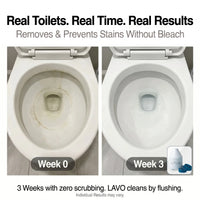
A LAVO pod sits in your toilet tank and releases a steady, controlled amount of citric acid with every flush. It naturally prevents the hard water ring from bonding to your porcelain, meaning you don't have to scrub the bowl. More importantly, it is 100% certified septic-safe. It contains zero bleach, zero chlorine, and zero ingredients that disrupt your tank's biological balance.
You get the clean bowl you want, without slowly killing the bacteria you desperately need.
See how the LAVO pod protects your toilet and your septic system here.